

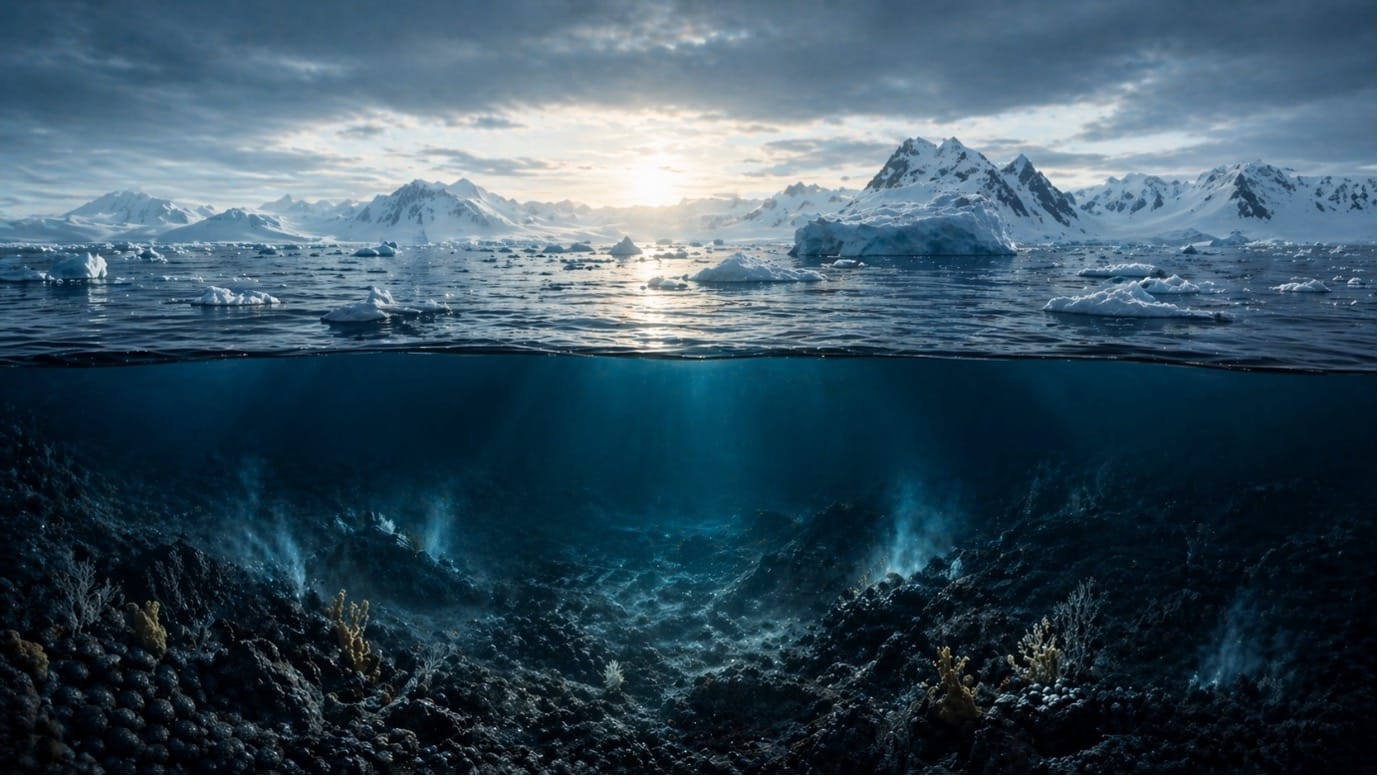
This article aims to explore a topic that lies at the frontier of both climate policy and geopolitics - Arctic deep-sea mining. It’s a story about the intersection of technological ambition, regulatory uncertainty, ecological fragility, and climate urgency.
So, what exactly do we mean by Arctic deep-sea mining? We’re talking about the extraction of minerals like manganese, cobalt, nickel, copper, and rare earth elements – materials essential for the energy transition – from depths often beyond 200 meters. These resources are found in polymetallic nodules, cobalt-rich crusts, and hydrothermal sulphide deposits scattered across the Arctic seabed. What makes this different from other ocean basins? Well, Arctic waters have long been protected by ice. But as the planet warms and sea ice recedes, previously inaccessible seabed areas are opening up – just as the demand for critical minerals is exploding. That’s no coincidence. Industry interest is intensifying. Energy transition technologies, the defence sector, the digitalisation industry, and various other sectors depend on these minerals.
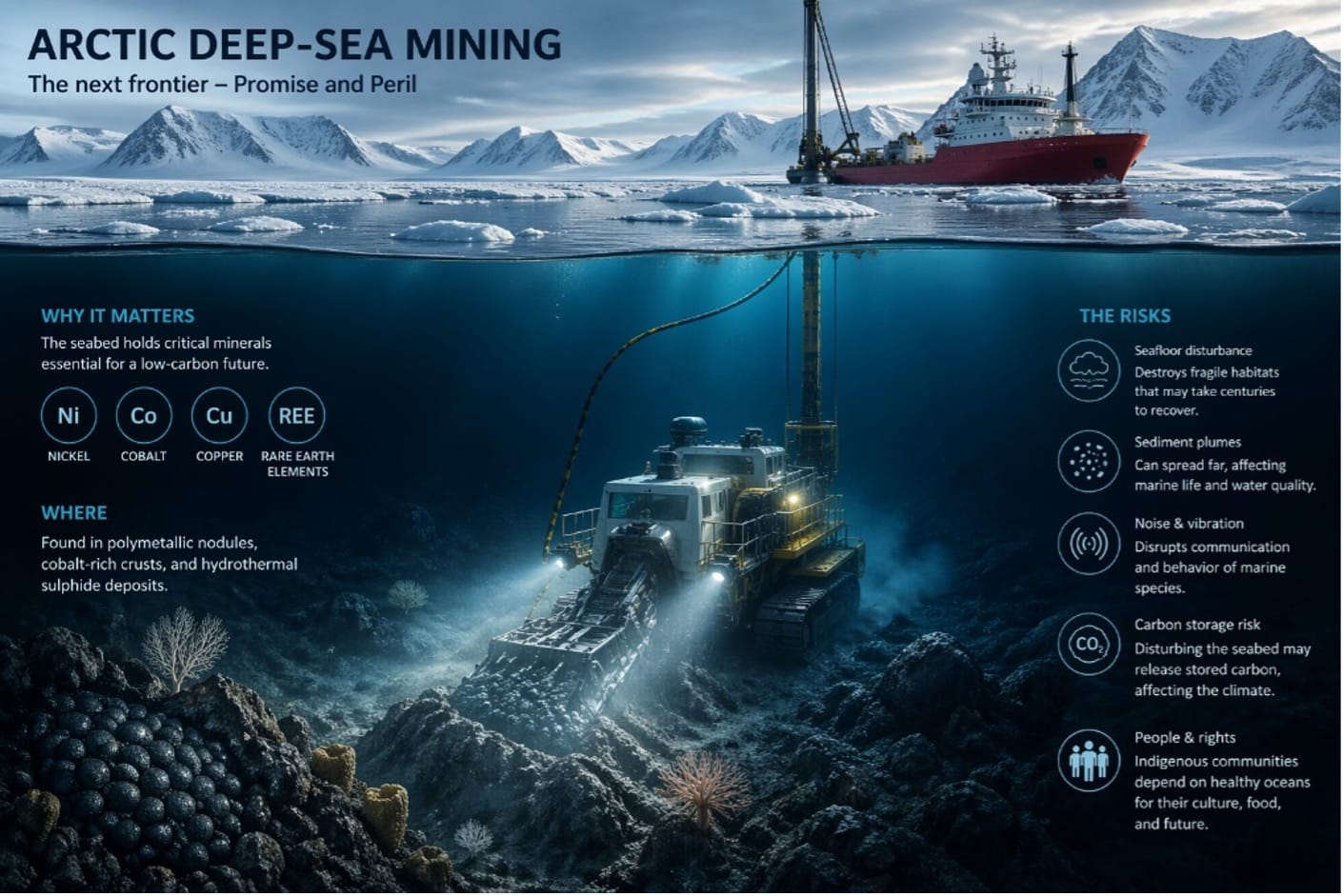
A conceptual illustration of Arctic deep-sea mining, showing the strategic interest in critical minerals beneath ice-covered waters alongside the environmental and societal risks associated with seabed extraction (AI generated image)
History and current momentum
Deep-sea mining, as an idea, isn’t new. It surfaced in the 1960s, grew briefly, and faded again in the 1980s due to high costs and legal uncertainty. Now, it’s back – repackaged as part of the “green” and other societal transitions. Interestingly, the Arctic Ocean holds a special place in the history of deep-sea mining. It was once primarily known as a source of tin for the Soviet Union. Now, the Arctic Ocean is being primed again – not just for exploration, but potentially as a lynchpin in global resource strategy. Norway has taken bold steps in this direction. In January 2024, it approved opening 281,000 square kilometres of its Arctic shelf to seabed mineral exploration – an area larger than the UK. While this didn’t authorize extraction yet, it marked a major geopolitical and industrial shift. And yet – by the end of 2024 – Norway’s licensing process was paused. A minority political party blocked the 2025 budget, and a lawsuit by WWF challenging the environmental assessment process is pending. So, we find ourselves at a moment of tension – between ambition and accountability.
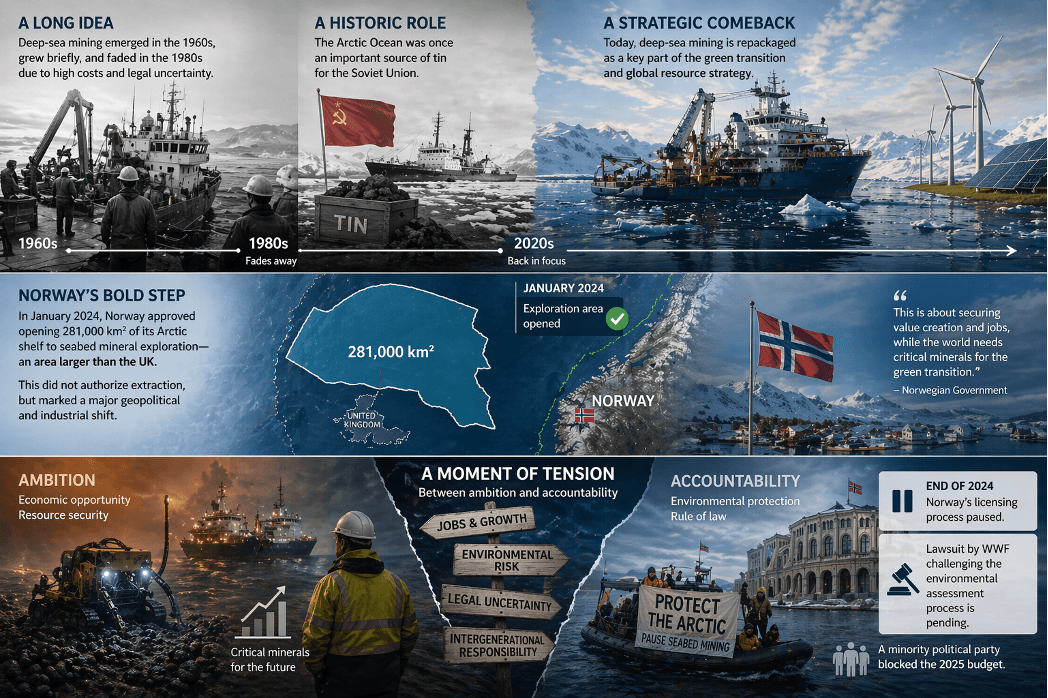
Arctic deep-sea mining has re-emerged from a long-dormant idea into a live political and industrial debate, with Norway’s 2024 exploration decision placing the region between resource ambition and environmental accountability (AI generated image)
Following the fault lines
My research is drawing on recent academic literature, policy documents, legal frameworks, and public debate to trace how Arctic deep-sea mining is taking shape before extraction has even begun. What emerged most clearly was not a single roadmap, but a series of fault lines. One of them is governance. Jurisdictionally, Arctic deep-sea mining is a patchwork: coastal states such as Norway claim rights over extended continental shelves under the “United Nations Convention on the Law of the Sea ” (UNCLOS), the “Interntional Seabed Authority” (ISA) governs areas beyond national jurisdiction, and international treaties such as “Convention for the Protection of the Marine Environment of the North-East Atlantic” (OSPAR), Espoo-convention, the “Convention on Biological Diversity” (CBD), and the Svalbard Treaty overlap without offering a unified system for managing cumulative impacts. In practice, regulation is fragmented. Another fault line is justice. Beneath legal and technical debates lies a more fundamental question: whose ocean is this? The world’s oceans are regarded as global commons, while industrial fishing depends on healthy marine ecosystems and Indigenous communities depend on Arctic marine ecosystems for food security and cultural survival, yet they have been only marginally included in seabed mining governance. The precautionary logic behind the Central Arctic Ocean Fisheries Agreement offers an important lesson here: pause first, study properly, and act only when the science is strong enough.
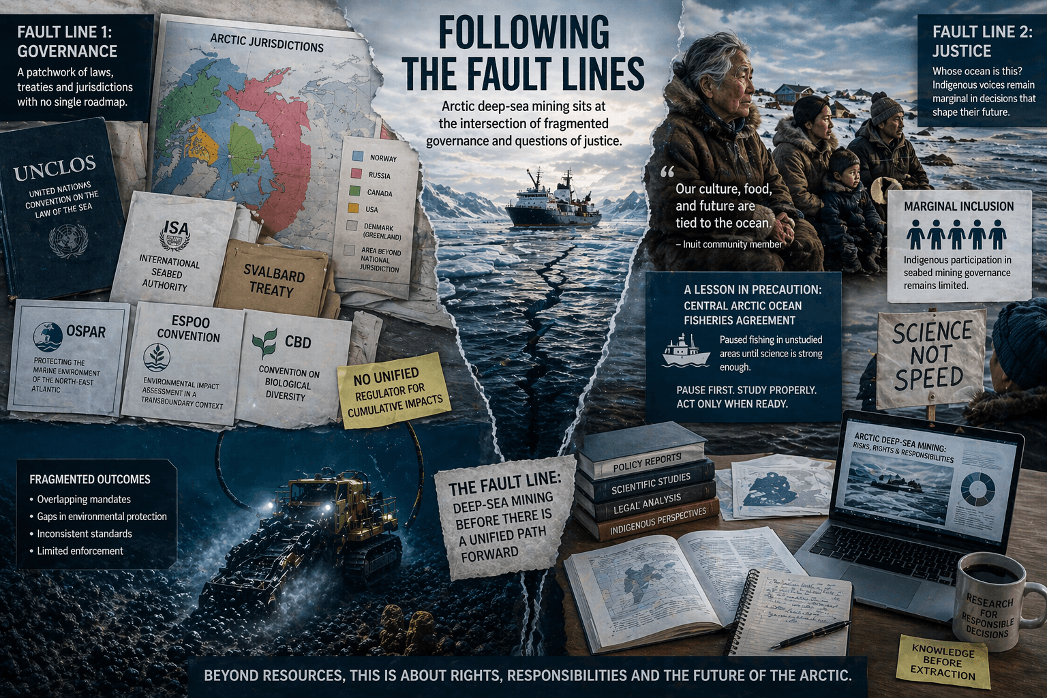
A desk-based view of Arctic deep-sea mining reveals two central fault lines: fragmented governance across overlapping legal regimes, and persistent justice questions over Indigenous inclusion, consent, and precaution (AI generated image)
The Future?
So, where are we headed? Norway’s next parliamentary cycle may revive the licensing process. The ISA had great expectations to finalize its Mining Code in 2025, but that target was missed. Most experts and member states now view the process as ongoing, with no certainty that the code will be ready for adoption by the end of 2026.The EU is calling for a global moratorium but continues to fund mining research. Meanwhile, companies face lawsuits and financing challenges, making commercial mining unlikely in the near term. But the pressure remains. As the “green”, digital and military transitions accelerate, so will demand for these minerals. Whether Arctic deep-sea mining becomes a legacy of sustainable innovation or another cautionary tale depends on what we do next.
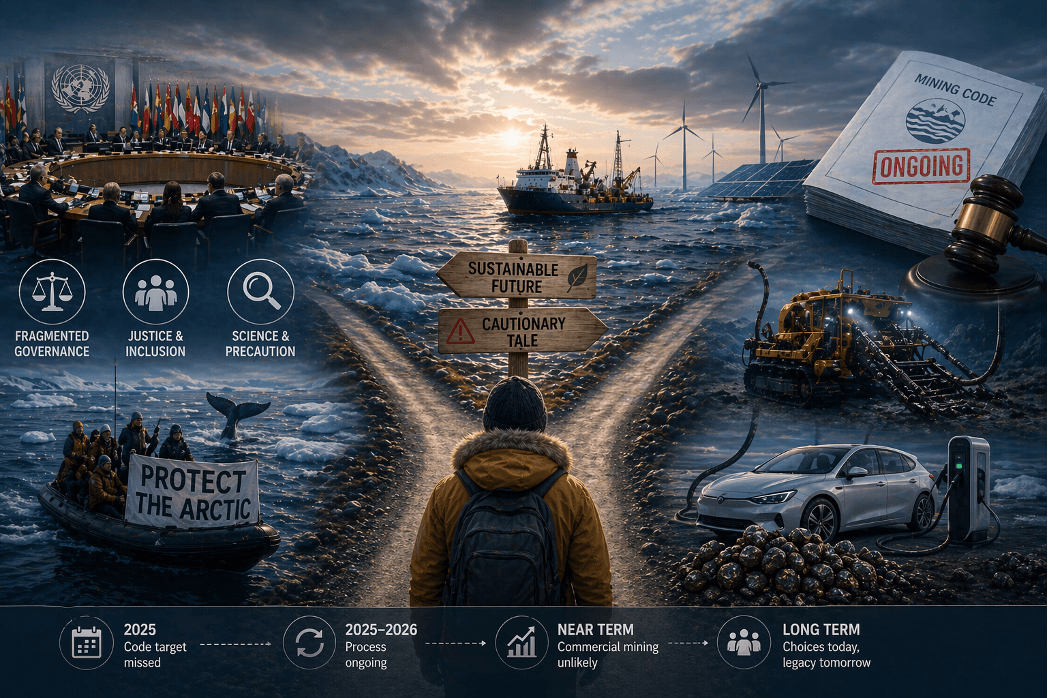
The future of Arctic deep-sea mining remains unresolved, shaped by unfinished regulation, political choice, commercial uncertainty, and the wider pressure of the green transition (AI generated image)
Media information
Written by Mag. Réka Marton.
Contact: use our contact form.
Layout by the APRI-Media Team.
Photos: © as indicated in the captions.
About the scientific author
Mag. Réka Marton, member of the APRI working group “Social and Cultural Systems”.
Related articles
The Arctic as a contested resource region
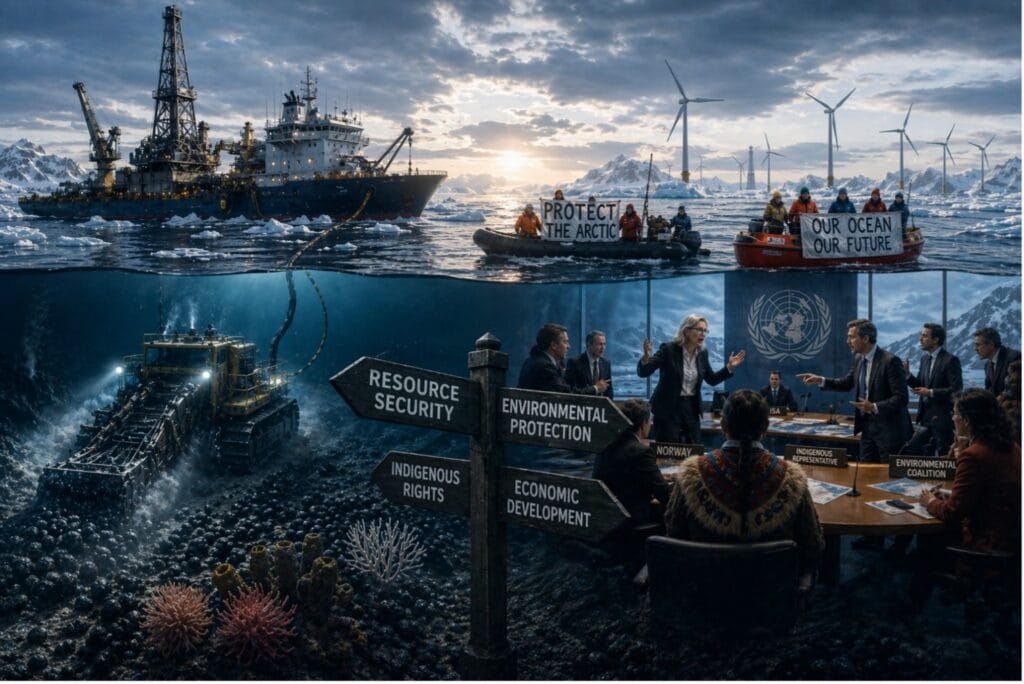
Arctic Deep-sea Mining at a Crossroads

Snow2School – Citizen Science in the Arctic and the Alps
Polar Talk #9 (in German)
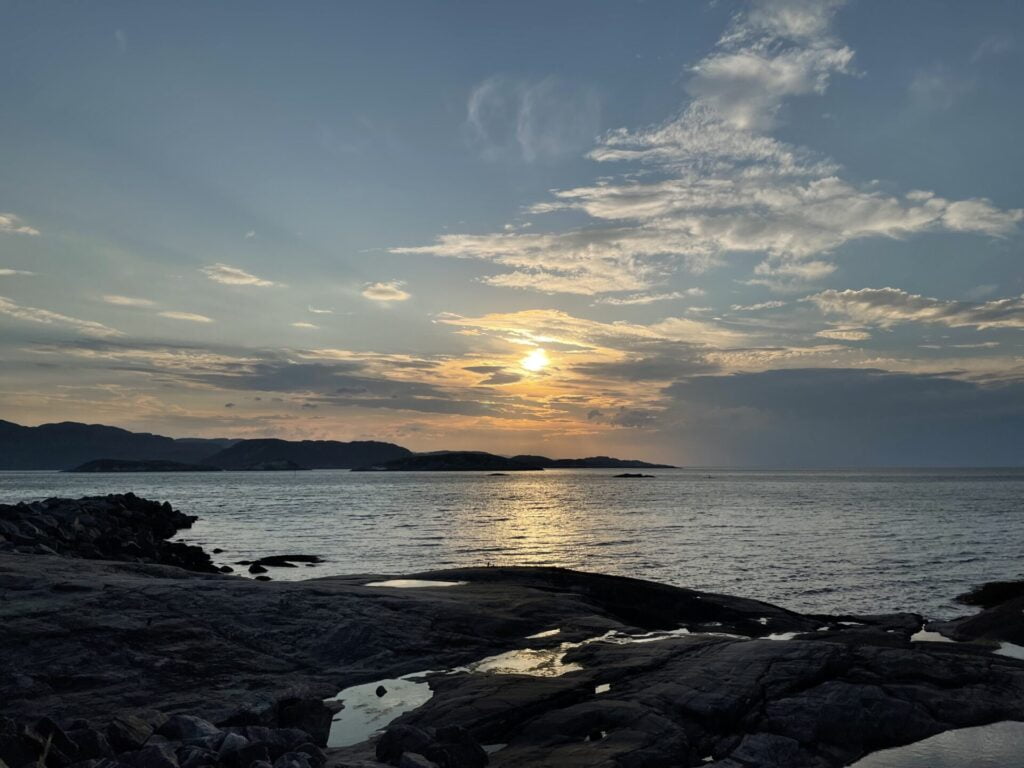
Arctic Coastal Communities: Global Connectivity and Ethnography of Maritime Infrastructure
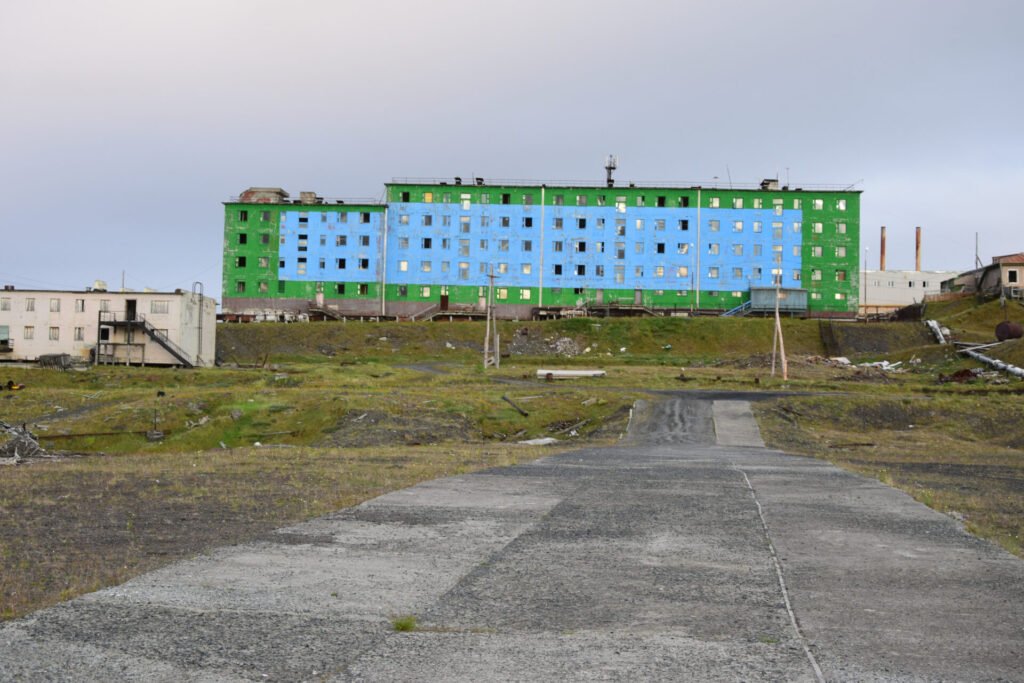
How much infrastructure do the people of the Arctic need?
References
Connolly, C. (2023). Under the Arctic Ice: Climate Futurism, Inuit Sovereignty, and Deep Seabed.
Mining in the Just Transition. Ocean yearbook, 37(1), pp.311–360.
Jardine, S. (2023). Treasures from an Icy Deep: The Demand for Arctic Deep Sea Mining. [Accessed 27 Nov. 2025].
Osland, E. (2025). Mining the Deep, Selling the Green : Norwegian deep-sea mining companies in constructing and legitimising their role within sustainability narratives. [Accessed 27 Nov. 2025].
Rasper, A. (2024). Norway suspends deep-sea mining plans in the Arctic. [Accessed 27 Nov. 2025]