
The race for natural resources in the Arctic is in full swing. Arguments about the security of supply for so-called critical raw materials - needed for the energy transition, digitalization, and the defense industry - place significant pressure on the communities where extraction takes place. In Indigenous contexts, this is increasingly understood in terms of 'green colonialism' and 'green extractivism'.
The Arctic and its natural resources
The Arctic[1], including its sub-Arctic reaches south of the Arctic Circle, is home to approximately four million people, half a million of whom are Indigenous and belong to over 50 language groups. It encompasses eight coastal states neighbouring the Arctic Ocean: Canada, the United States, Sweden, Norway, Finland, Russia, Iceland, and Greenland/Denmark. Although the Arctic is often imagined as endless expanses of virtually untouched nature, it is also urbanized and industrialized due to the extraction of the mineral resources located there.
The region is increasingly coming into the international spotlight in the wake of socio-technological transformations – such as electromobility, renewable energy, and hyper-digitalization – as well as the expansion of the defense and construction industries. All of them require socalled strategic and critical raw materials – a classification of materials used by many countries and the EU (see among others European Union 2024). These include raw materials such as rare earth elements, lithium, cobalt, copper, graphite, nickel, germanium, and others, for which future demand is expected to increase massively by 2050, according to analysts (Melcher 2024). The “criticality” of critical raw materials is not necessarily determined on geological conditions, but rather stems from forecasts of future trends and demand based on economic and geopolitical conditions that affect the security of supply chains.
The geologically proven abundance of raw materials in the Arctic could provide a solution in times of supply chain uncertainty and reduce global dependence on China as one of the leading producers of raw materials – according to the narrative put forward by policymakers, industry, and the financial sector. The current public discourse on the Arctic as a new frontier for raw materials overlooks the fact that, due to the duration of geological exploration, securing investments, permitting processes, and negotiations with local communities, projects can sometimes take decades before actual extraction begins. Furthermore, the climatic conditions in the Arctic complicate both exploration and extraction.
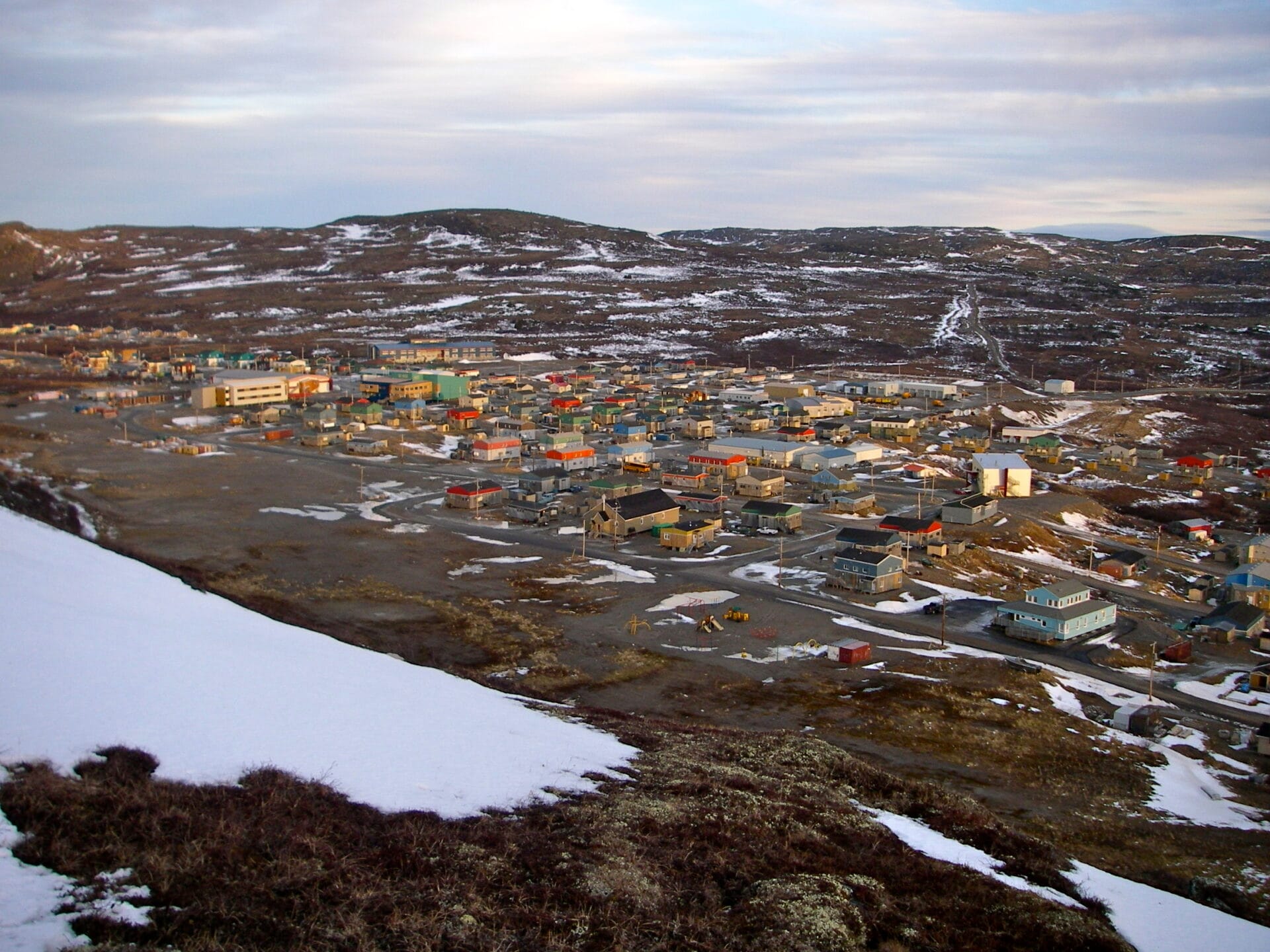
Kangiqsualujjuaq, Matimekush Lac John Region, close to the Strange Lake project, home of the Innu Nation, impacted by potential mining activities. ©Thierry Rodon
The current rush for resources in the Arctic is not a recent phenomenon. Colonial violence and land grabs in the course of resource exploitation have shaped its history. This ranges from fur hunting and trading during the Tsarist conquest of Siberia in the 16th century, through commercial whaling from the 17th century onward, to North American settler colonialism starting in the 19th century. The port of Narvik in Norway, with its railway connection to Kiruna in Sweden, became an infrastructural hub for European iron ore supply chains in the early 20th century. In the Soviet Union, Arctic mining towns centered around the extraction of coal, nickel and diamonds emerged starting in the 1930s (until the 1950s under Gulag forced labor). With the Trans-Alaska Pipeline from the North Slope to Valdez, the local Indigenous Iñupiat communities became part of the U.S. oil industry starting in the 1970s.
Resistance to environmental pollution, racism, and social discrimination led to regional Indigenous political self-determination movements, which resulted in the recognition of Indigenous land rights – including rights to mineral resources and Indigenous self-governance – in some regions of Canada in the second half of the 20th century. This includes consultation rights regarding the development of mining and infrastructure projects, which follow the principle of free, prior, and informed consent (FPIC; United Nations 2007) (though without a veto right). The conclusion of so-called Impact and Benefit Agreements between project proponents and Indigenous communities is now widespread in Canada and may include, among other things, profit-sharing arrangements. However, such instruments do not necessarily lead to Indigenous consent (Saxinger 2021). In the European Arctic coastal states, the Indigenous Sámi are demanding adjustments to national Indigenous rights regarding consultation and consent in land-use planning, which they find unsatisfactory. In Arctic Russia, Indigenous representatives and activists – who gained increasing political visibility in the 1990s and 2000s – are now facing massive state repression.
With regard to the acceptance of mining in Indigenous communities living near or affected by mining sites and their operation, it should be noted that these communities are not homogeneous; rather, opinions on the pros and cons of mining vary widely among the local population, particularly when the industry has also become a major employer for Indigenous people.
Green extractivism and green colonialism in the Arctic
In the context of critical politics and civil society in the Arctic, the terms “green colonialism” and “green extractivism” have become established in recent years in relation to mining and renewable energy production (Fjellheim 2023). The term “extractivism” originated in Latin America and refers to the large-scale exploitation of resources, primarily by transnational corporations, which are exported without significant domestic processing or local value creation and are often accompanied by conflicts with local residents (Hamilton 2022). The term critiques the socio-ecological costs of mining, which can include involuntary land grabs, population resettlement, a lack of participation in shaping regional development, environmental pollution, and changes to lifestyles in the region.
The concepts of “green” extractivism and “green” colonialism additionally highlight how colonial structures can persist in the context of global decarbonization efforts. The narrative that raw materials are primarily used for the energy transition obscures the fact that the majority of them are also consumed in other (non-green) sectors. Affected local communities in particular criticize that societies and policymakers in the global centers of raw materials consumption seem to expect that the social and ecological costs of the energy transition will be borne by the peripheries. Two case studies[2] below address this complex issue.
An uncertain future in Nunavik (Canada) – the Strange Lake rare earth elements project
The Strange Lake project, currently in the exploration and permitting phase, is part of Canada’s strategy to increase national production and processing capacity and secure supply chains. The private Canadian company Torngat Metals Ltd. plans to begin mining rare earth elements in the region in 2030 (Naskapi 2024, Torngat Metals 2024, KEQC 2025). Canada’s Critical Minerals Strategy classifies these raw materials as critical and of strategic importance for the energy transition and the defense sector (IEA 2022, Government of Canada 2024).
The Strange Lake region is located at the border of the two provinces Quebec (Nunavik) and Newfoundland and Labrador (Nunatsiavut). It is home to culturally significant sites of the Indigenous Innu, Naskapi, and Inuit peoples who live there and use the region for subsistence hunting and fishing (NunatuKavut Community Council, 2023). Initial attempts to mine the region’s mineral deposits already started in the late 1970s, but these were abandoned due to lack of funding, ongoing tensions regarding local value creation, environmental protection, and the involvement of Indigenous communities.
The complex mining and environmental laws, along with the regulations governing consultation mechanisms with Indigenous communities – which stem from overlapping jurisdictions at the federal, state, provincial, and indigenous administrative levels – lead to lengthy procedures and decision-making processes, as well as heightened tensions among the stakeholders involved.
Some of the affected Indigenous communities, parts of the non-Indigenous local population, and environmental groups are actively opposing the project. They fear negative impacts on local ecosystems – especially for the caribou population – and health, they also criticize insufficient inclusion in consultation processes. Torngat Metals Ltd., on the other hand, claims to adhere to exemplary environmental and social conduct and asserts that it follows the due diligence standards of international organizations.
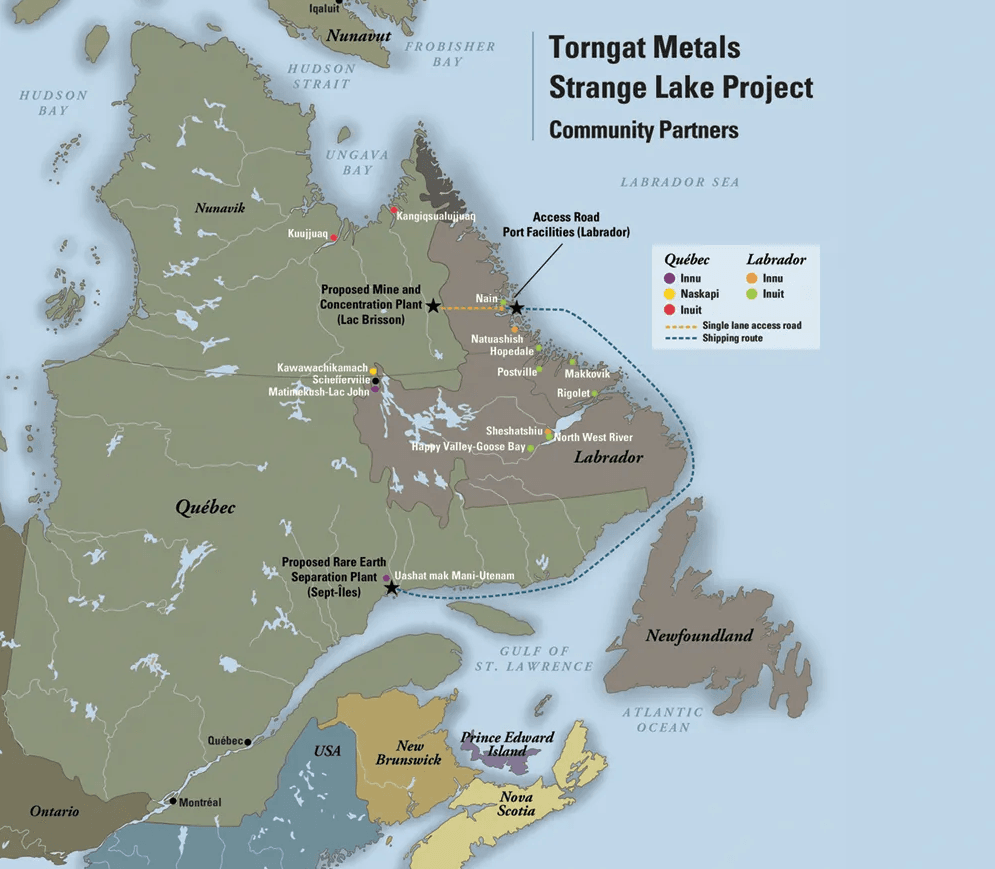
Location of the Strange Lake Project (between the two provinces Quebec (Nunavik) and Newfoundland and Labrador (Nunatsiavut)). ©Torngat Metals
An Arctic fjord at the center of European resource policy – the Nussir copper project
The Canadian company Blue Moon Metals is currently planning a copper project located directly on Repparfjord (Sámi: Riehpovuotna) in the province of Finnmark in Norway – a fjord whose waterways have been protected by the government since 1987. This area is also part of Sápmi, the cultural homeland and subsistence area of the Indigenous Sámi people, spanning across parts of Norway, Sweden, Finland, and Russia. The targeted deposit is estimated to contain 74 million tons of copper ore, placing it in the spotlight of European resource policy and international investors.
The Norwegian company Nussir ASA has been working to launch the mining project for 20 years. Following the merger with Blue Moon Metals and its classification as a Strategic Project under the Critical Raw Materials Act (European Union 2024) in the summer of 2025, the first blasting operations were initiated to create access to the planned underground mine.
Despite nationwide protests by the Sámi and environmentalists, the Norwegian government approved the copper mining project in 2019. The Sámi view this as a violation of their right to free, prior, and informed consent (FPIC), as enshrined in the UN Declaration on the Rights of Indigenous Peoples (United Nations 2007), and continue to protest both at the project site and across national borders. A key point of criticism is the plan to dump toxic mine tailings into the protected Repparfjord. Norway is one of the few countries worldwide where so-called mine waste dumping is permitted. Furthermore, the mine is located on important grazing land for reindeer, which are central to the existence of the Sámi people, both economically and culturally. The mining activities pose a threat to the reindeer population because the animals retreat to the area of the planned mine to calve. The Norwegian government, however, sees the project as another opportunity to advance the industrial development of Norway’s Arctic regions and centers the narrative of the green transition (Nilsen 2019).
Repparfjord (Sámi: Riehpovuotna) in the province of Finnmark in Norway. ©Google
Defending the Arctic against green extractivism and green colonialism
It is highly likely that the Arctic will continue to establish itself as a prime location for mining in the future, even though new exploration and extraction projects can only be implemented slowly due to the climatic and political-regulatory conditions, as well as partial opposition to projects by local residents and communities and the comparatively high investment requirements. Essential prerequisites for socially and environmentally sustainable resource extraction include local and Indigenous participation in the decision-making process (e.g., FPIC) and profit-and benefit-sharing agreements with the local population and communities, rigorous environmental and social impact assessments, and corporate responsibility throughout the entire mining cycle, the implementation of the highest technological, labor law, and environmental standards, as well as political transparency regarding realistic expectations for labor market, demographic, and regional development. Although Indigenous positions within communities can be highly heterogeneous, they have not forgotten the massive negative consequences of Arctic colonialism and today remain deeply concerned whenever projects are undertaken in the name of overarching national interests: There is a fear that extractivism and colonialism (in the sense of land grabs without local participation) are now masquerading as “green” initiatives and threatening Indigenous cultures and local economic systems.
Radio show “Who Owns the Arctic? (in German)“
Listen to the ORF show “Who Owns the Arctic?” from January 28, 2026, on Ö1. The guest was APRI researcher Prof. Gertrude Saxinger.
Host: Barbara Zeithammer
[1] In defining this region, we refer to the definition provided in the Arctic Human Development Report (Einarsson et al. 2004). There is no universally accepted demarcation of the areas north and south of the Arctic Circle.
[2] The two case studies are drawn from the authors’ professional contexts and should be viewed as illustrative rather than scientifically representative. Nevertheless, they provide valuable insights into socio-ecological issues that may arise in the context of mining projects in the Arctic.
Media information
Written by Gertrude Saxinger, Marlene Auer, Dorothea Hamilton, Hannah Pilgrim, Thierry Rodon.
Contact: use our contact form.
Layout by the APRI-Media Team.
About the scientific authors
Gertrude Saxinger is a professor of Applied Integrative Geography at the University of Graz and a member of the Austrian Polar Research Institute (APRI). She leads the project “Beyond Hot Air – Conversations around critical raw materials supply for the ‘green’ transition.” She has been conducting research on the raw materials industry in the Arctic for 20 years.
Hannah Pilgrim, a human geographer and social scientist, coordinates the nationwide civil society network “AK Rohstoffe” at the Berlin-based NGO PowerShift e.V. For more than ten years, she has been examining the ecological, human rights, and social impacts of German and European raw materials policy.
Dorothea Hamilton is a geographer who earned her Ph.D. on extractivism in Latin America. She is currently working as a postdoc on the transdisciplinary project “Resources in Transformation (ReForm)” at the FernUniversität in Hagen, focusing on issues related to resource extraction and conflict prevention in the context of changing raw material demands.
Marlene Auer is currently completing her master’s degree in political science. She is a research assistant in the project “Beyond Hot Air – Conversations around critical raw materials supply for the ‘green’ transition” and a member of the Austrian Polar Research Institute (APRI).
Thierry Rodon is a Professor of Political Science at Université Laval in Canada. His research examines the relationships between Indigenous communities and resource extraction industries in northern Canada, Scandinavia and Australia, with particular attention to land rights, benefit-sharing, and the implementation of Free, Prior and Informed Consent (FPIC).
References:
Einarsson, N. et al. (Hrsg.) (2004). Arctic Human Development Report. Stefansson Arctic Institute. https://www.svs.is/static/files/images/pdf_files/ahdr/English_version/AHDR_first_12pages.pdf
European Union. (2024). Regulation (EU) 2024/1252 of the European Parliament and of the Council of 11 April 2024 establishing a framework for ensuring a secure and sustainable supply of critical raw materials and amending Regulations (EU) No 168/2013, (EU) 2018/858, (EU) 2018/1724 and (EU) 2019/1020. http://data.europa.eu/eli/reg/2024/1252/oj
Fjellheim, E. M. (2023). “You can kill us with dialogue”: Critical perspectives on wind energy development in a Nordic-Saami green colonial context. Human Rights Review, 24: 25-51. https://doi.org/10.1007/s12142-023-00678-4
Government of Canada. (December 20, 2024). Canada to unlock critical minerals rare earth development in Northern Quebec and Labrador with new funding. https://www.canada.ca/en/natural-resources-canada/news/2024/12/canada-to-unlock-critical-minerals-rare-earth-development-in-northern-quebec-and-labrador-with-new-funding.html
Hamilton, D. (2022). Andengold: Bergbaufluch in (Post-)Bürgerkriegsländern Lateinamerikas. Springer VS Wiesbaden.
International Energy Agency (IEA). (2022). Critical minerals list 2021. https://www.iea.org/policies/15698-critical-minerals-list-2021
Kativik Environmental Quality Commission (KEQC). (2025). Strange Lake rare earth mining project. https://www.keqc-cqek.ca/en/projets/strange-lake-rare-earth-mining-project/
Melcher, F. (2024). Types and quantities of Critical Raw Materials needed to meet growing demands in the European Union and worldwide. Beyond Hot Air Briefing Papers Issue 1. https://doi.org/10.25365/phaidra.541
Naskapi Nation of Kawawachikamach. (2024). Strange Lake rare earth project. https://naskapi.ca/2024/08/17/strange-lake-rare-earth-mining-project-environmental-impact-review-and-public-participation/
Nilsen, T. (April 14, 2019). Minister says controversial copper mine needed for the green shift. The Barent Observer. https://www.thebarentsobserver.com/industry-and-energy/minister-says-controversial-copper-mine-needed-for-the-green-shift/113405NunatuKavut Community Council. (December 8, 2023). Comments on the initial project description (and summary of the initial project description) for the Strange Lake rare earth mining project. https://registrydocumentsprd.blob.core.windows.net/commentsblob/project-85969/comment-61622/NunatuKavut%20Community%20Council%20Comments%20on%20the%20Strange%20La
Saxinger, G. (2021). Social dimensions of mining in Yukon Territory. In: S. Glomsrød, G. Duhaime, G., I. Aslaksen (Hrsg.): The Economy of the North – ECONOR 2020 (pp. 116-117). Arctic Council Secretariat.
Torngat Metals. (2024). Strange Lake rare earth mining project. https://iaac-aeic.gc.ca/050/documents/p85969/157595E.pdf
United Nations. (2007). United Nations Declaration on the Rights of Indigenous Peoples. https://www.un.org/development/desa/indigenouspeoples/wp-content/uploads/sites/19/2018/11/UNDRIP_E_web.pdf