

Glaciers are much more than just spectacular landscape features. They store fresh water, regulate the climate, shape ecosystems and are home to unique, often invisible and sensitive biodiversity (e.g. microorganisms, glacier fleas, etc.).
In the International Year of Glacier Preservation, the Austrian Polar Research Institute (APRI) took the opportunity to raise awareness of the central role played by glaciers among the general public, politicians and decision-makers. A key objective was to use three overarching approaches not only to communicate scientific findings, but also to promote concrete action:
- Raising awareness
Making the importance of glaciers for life on our planet visible and understandable. - Combining research and practice
Using scientific findings to protect glaciers and mitigate the ecological and economic consequences of their decline. - Strengthening public relations and science communication
Using alternative formats such as art exhibitions to reach not only a specialist audience, but also broader sections of the general public and decision-makers.
Science in dialogue – lectures, exhibitions, podcasts and discussions
Members of APRI as well as the APRI as an institution contributed to deepening the dialogue between science and society by organising a wide range of events. Lectures, discussions and interactive formats reached different target groups and highlighted the central aspects of glacier conservation and glacier retreat. Selected activities are briefly presented below:
“We wanted to raise awareness of the central role played by glaciers among the general public, politicians and decision-makers.”
Birgit Sattler, APRI director

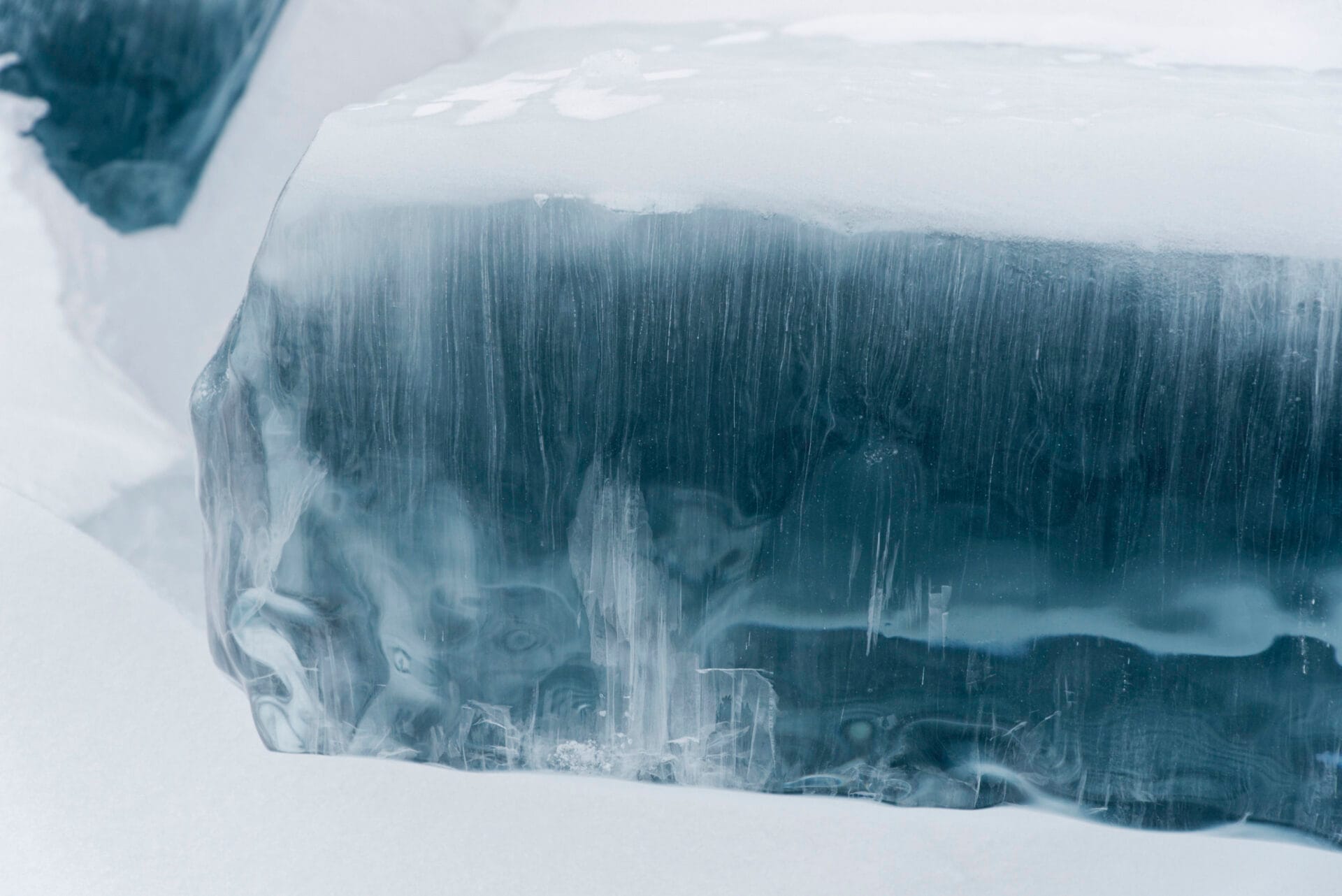
Ice detail with air holes (© Christoph Ruhsam)
URBI Science Talk and geo-colloquium: In the shadow of climate change – What remains of the eternal ice?
On 21 March, UN World Glacier Day, an event on glacier retreat and climate change was held in the ballroom of the “Meerscheinschlössel” in Graz. In keynote speeches, four researchers from the University of Graz and the Austrian Academy of Sciences highlighted the current state of glacier research with a special focus on Austria and the Arctic. APRI members Wolfgang Schöner and Jakob Abermann outlined the dramatic developments in the Alps and Greenland and presented current research projects and future prospects. Andreas Trügler, scientific director of Austria’s first polar research station “Sermilik” in Greenland, provided insights into the work of the station and emphasised its central importance for the long-term documentation of glacier changes. The video recording of the presentation is available here.
Source: https://urbi.uni-graz.at/de/neuigkeiten/urbi-science-talk-im-schatten-des-klimwandels/
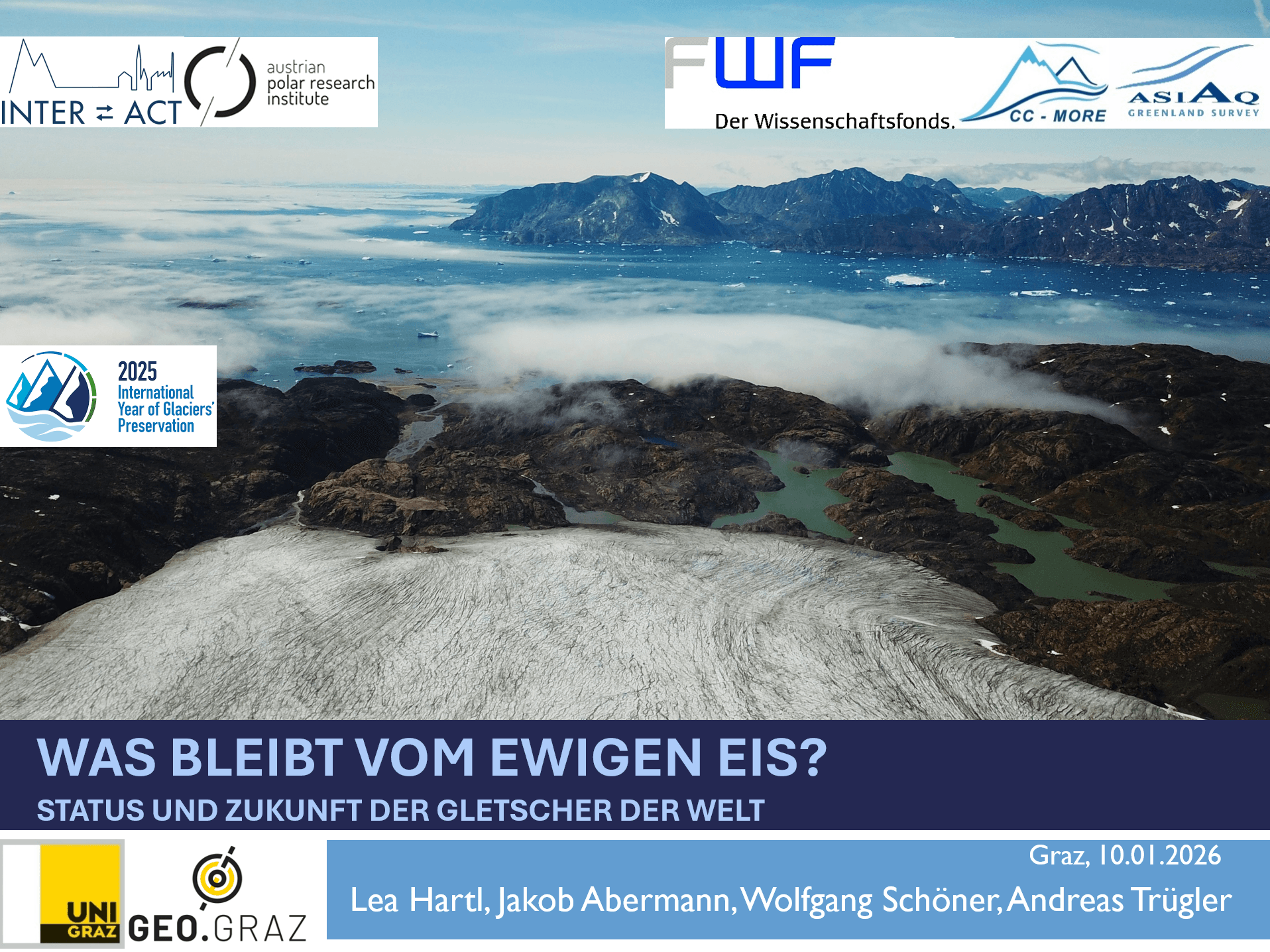
Presentation cover (© Jakob Abermann)
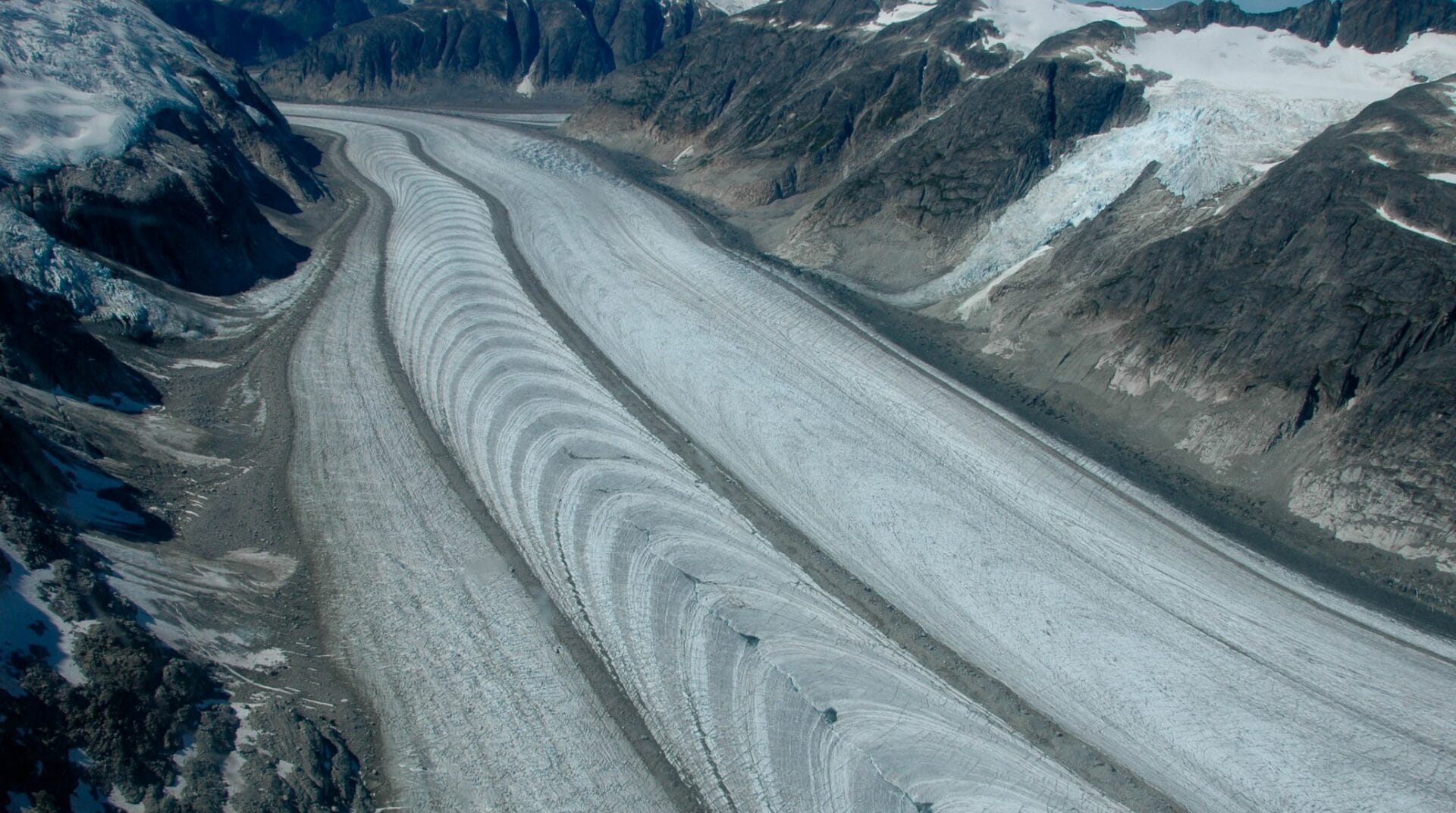
Greenland glacier (© Jakob Abermann)
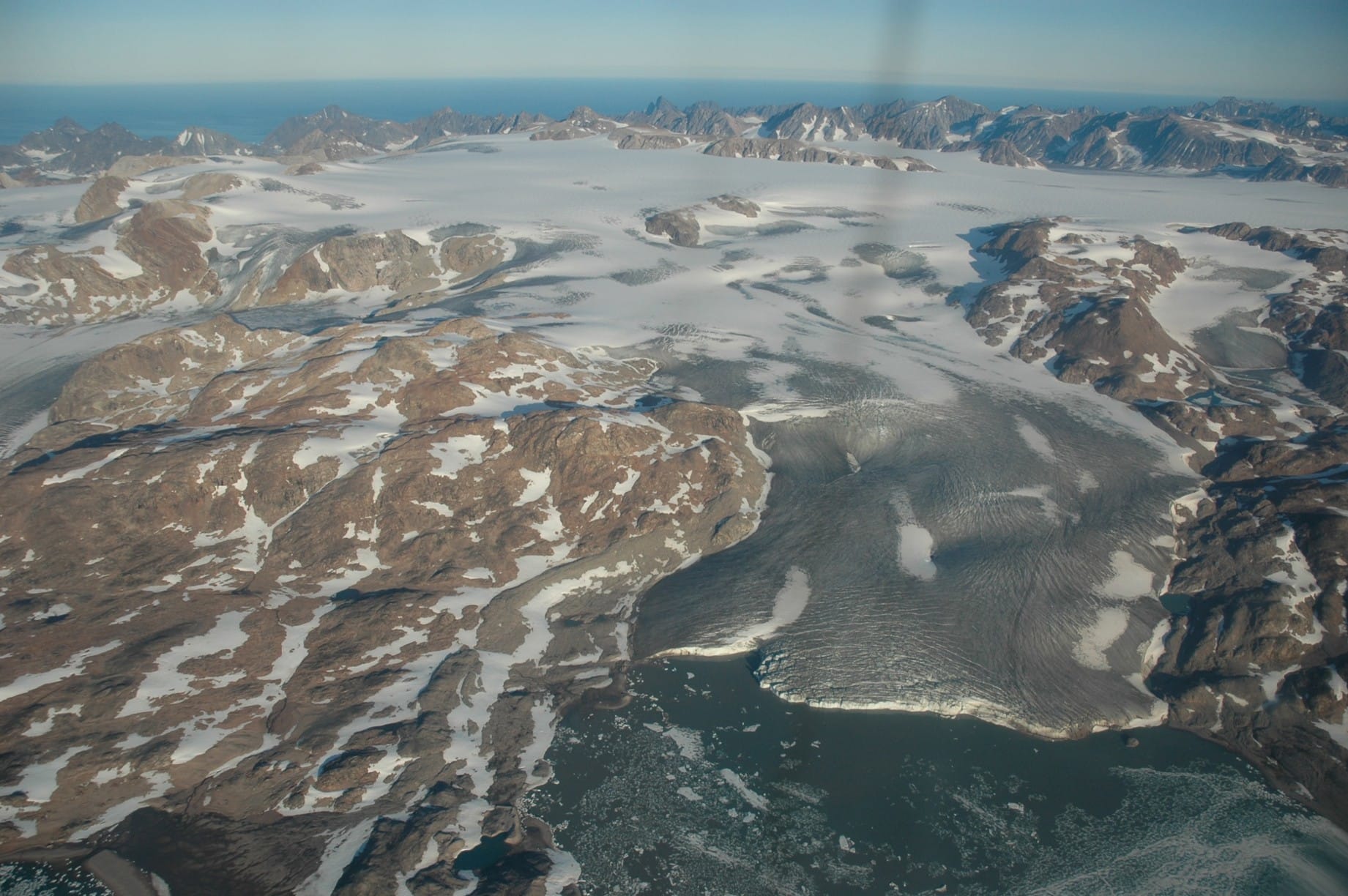
Greenland glacier (© Jakob Abermann)
Ice Matters – Glaciers count
On 20 March 2025, keynote speeches and a panel discussion on glacier protection took place at the Alpinarium Galtür, Tyrol. Researchers and stakeholders discussed the consequences of glacier retreat. APRI Director Birgit Sattler presented her research on life in the ice, which she conducted at the Jamtalferner glacier in Tyrol as well as in the Arctic and Antarctic. She showed that glaciers are independent habitats with unique biodiversity that are increasingly threatened by melting processes and anthropogenic influences such as microplastics and pesticides.

Glacier ice details (© Klemens Weisleitner)

Glacier ice details (© Klemens Weisleitner)
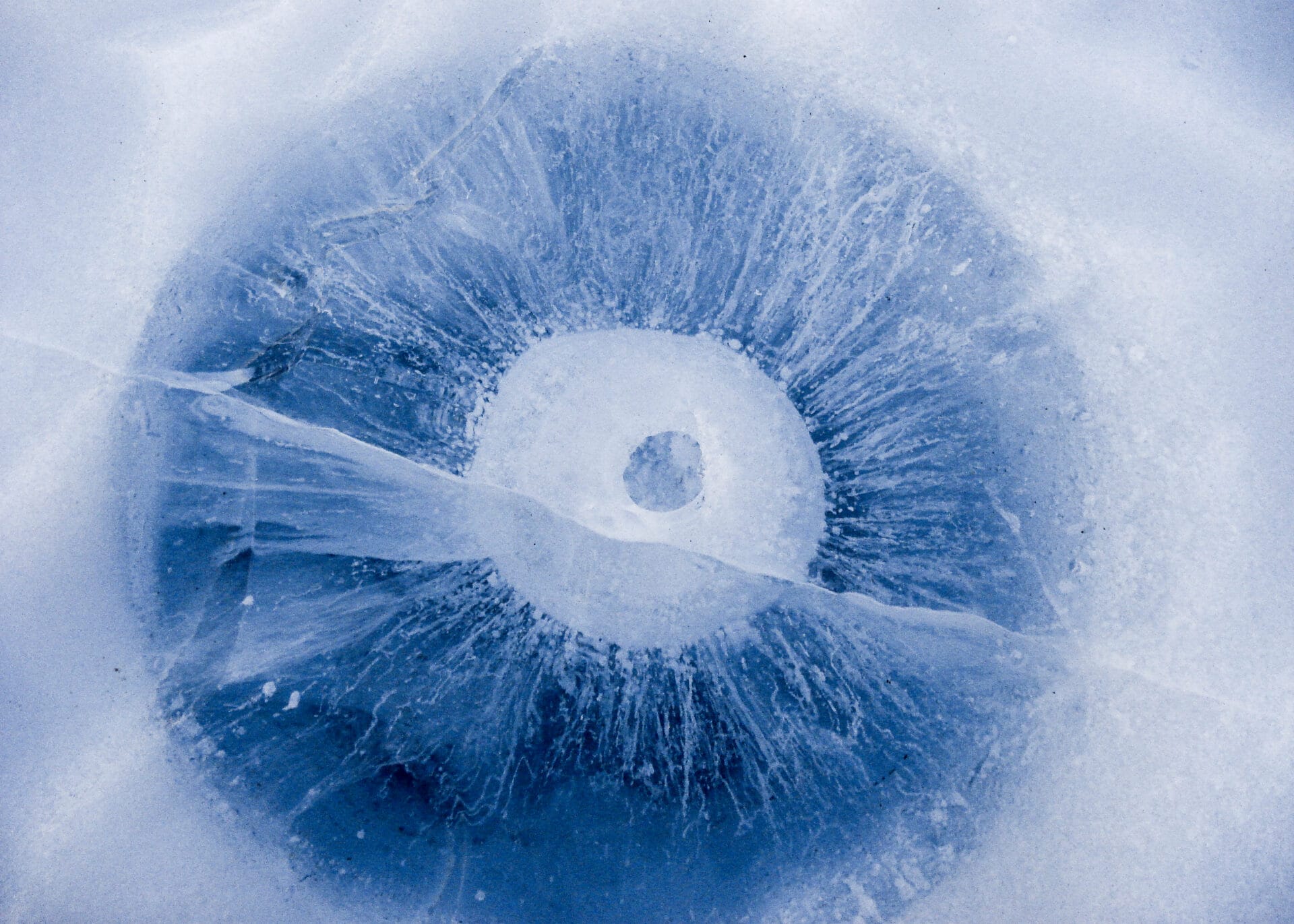
Glacier ice details (© Klemens Weisleitner)
Birgit Sattler is also a protagonist on the topic of glacier protection sheets and their impact on aquatic ecology in Harry Putz’s film “Requiem in White”:
https://freiluftdoku.com/requiem-in-weiss/.
Glacier Stewardship Program
Birgit Sattler is co-founder of the Glacier Stewardship Program. The alliance of researchers from the University of Innsbruck, ETH Zurich and EPF Lausanne has set the goal of addressing the challenges and consequences of glacier retreat through three key areas of focus:
- The program will develop new technical approaches in collaboration with municipalities and stakeholders to slow down ice loss at the local level, and systematically evaluate and test these approaches.
- Early warning systems should be promoted to better protect communities in some of the world’s most vulnerable mountain ranges from glacier-related hazards.
- The loss of glacial ice means that future generations of researchers will no longer be able to study the microorganisms trapped in the ice. The program aims to establish a unique bio-database – a microbial zoo – to preserve glacial microorganisms for future generations and harness their power to mitigate the effects of climate change.
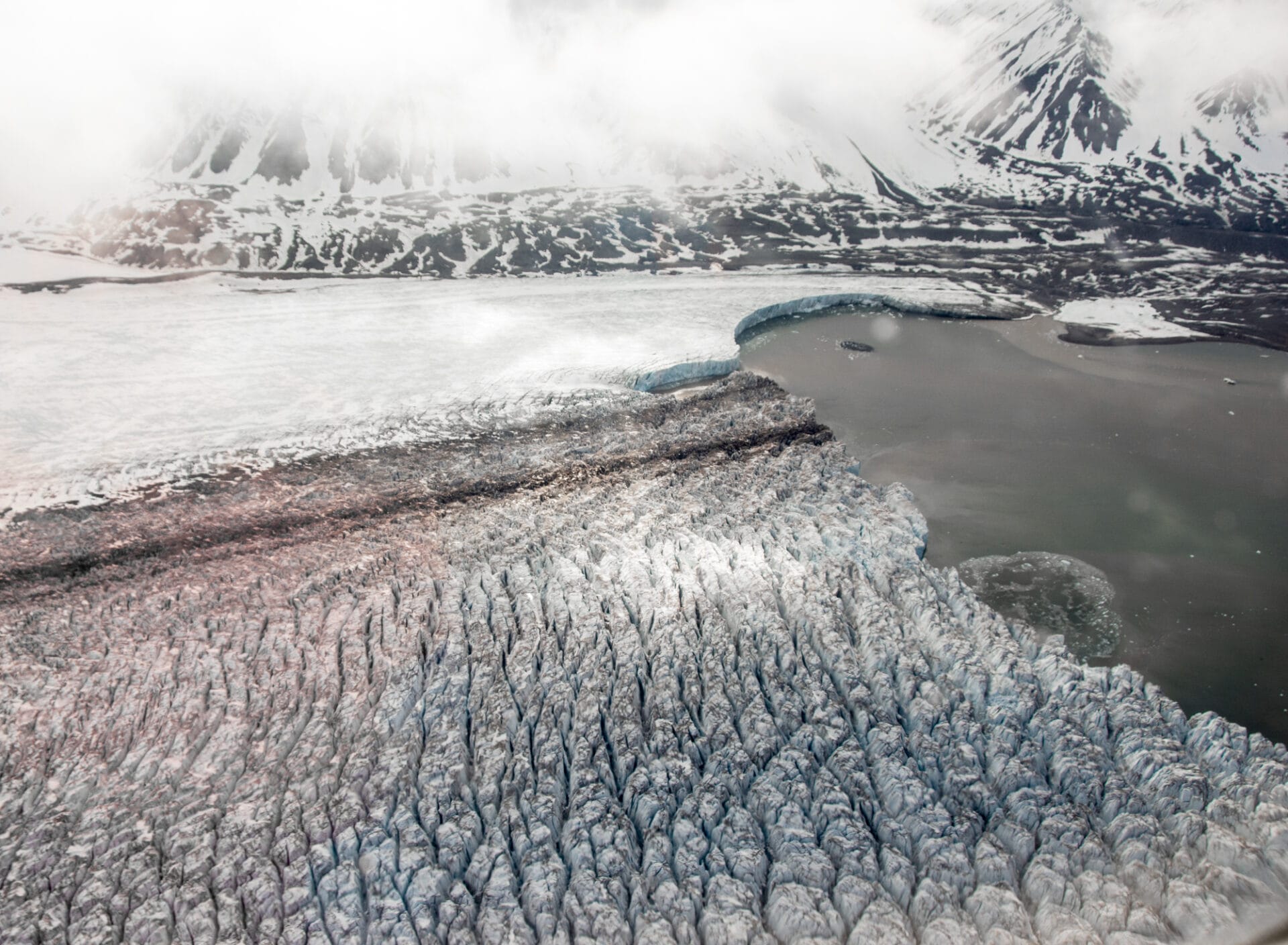
Glacier front, Spitsbergen (© Klemens Weisleitner)
Polar Talks
The Polar Talks, organised in collaboration with the Natural History Museum Vienna, have become an established series of lectures by APRI, with the aim of making polar research accessible to a wide audience. Researchers from the natural and social sciences report on their work in the polar regions in a way that is easy for everyone to understand.
In the International Year of Glacier Conservation, a total of three Polar Talks took place in 2025, addressing various aspects of polar research and the role of glaciers as habitats, climate witnesses and social mirrors.
Polar Talk #17 – Young Perspectives on the Polar World
On 9 April 2025, the 17th Polar Talk took place in collaboration with APECS Austria, the Association of Polar Early Career Scientists. Young scientists (Florina Schalamon, Carolin Hirt, Victoria Martin, Philip Krogull, Susanna Gartler, Marie Schroeder and Jonathan Fipper) presented their interdisciplinary research on the Arctic. The topics ranged from the analysis of historical and current climate data to the energy balance of ice cliffs, permafrost microbiology and political science concepts for the Arctic. The evening underscored the central role of young researchers for the future of polar research.
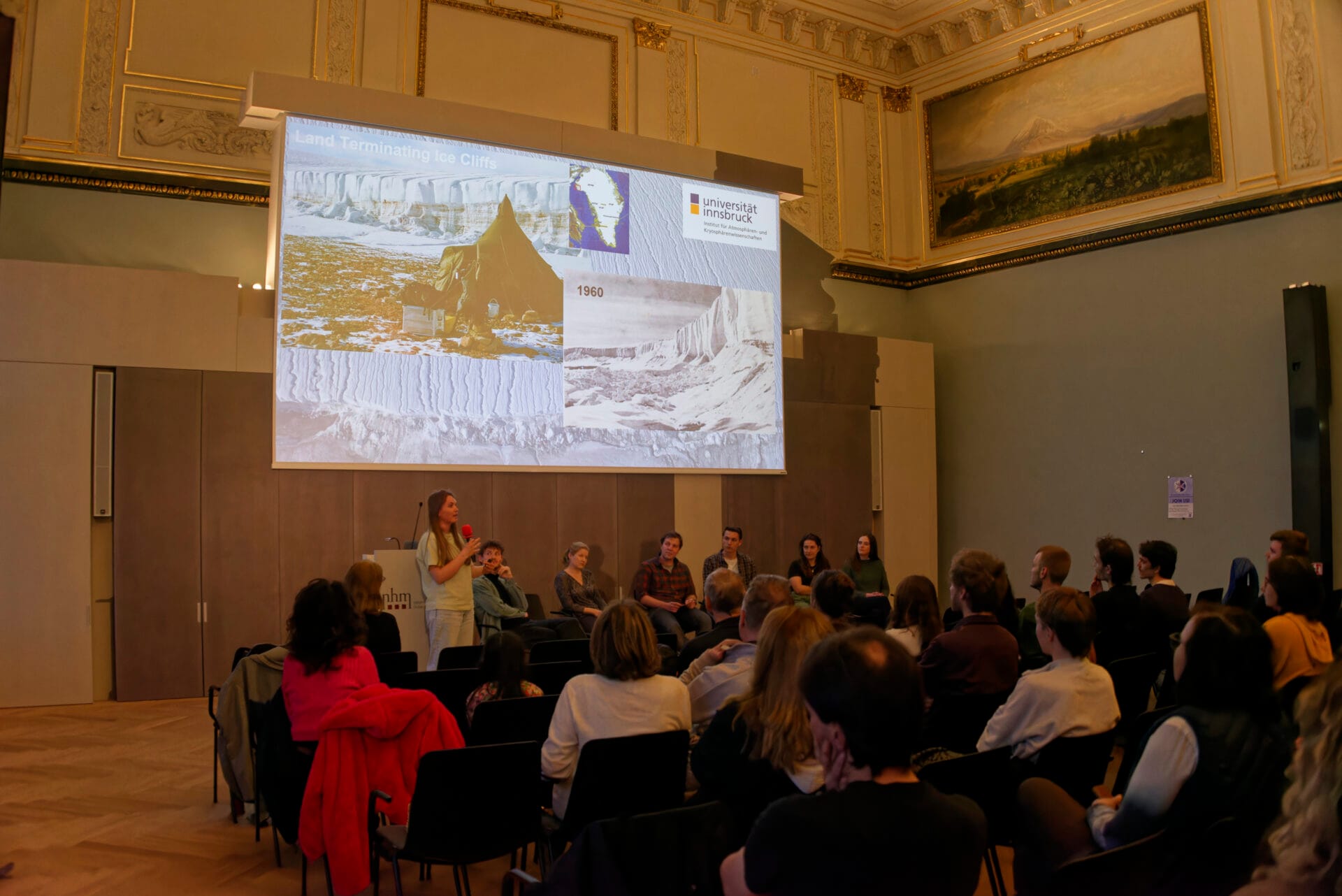
Polar Talk #17 at the Natural History Museum Vienna (© Christoph Ruhsam)
Polar Talk #18 – Snow and ice as mirrors of our society
The 18th Polar Talk on 4 June 2025 focused on the multifaceted significance of snow and ice in high mountains and polar regions. APRI director Birgit Sattler showed that glaciers are not only water reservoirs, but also habitats, cultural symbols and archives of human activity. She illustrated how closely the loss of snow and ice is linked to societal decisions and global ecological consequences.

Entrance to the lecture room of Polar Talk #18 at the Natural History Museum Vienna (© Christoph Ruhsam)
Polar Talk #19 – Sermilik Research Station: First insights into the new Austrian research station in the Arctic
On 12 November 2025, the Sermilik Research Station on the east coast of Greenland was the focus of the 19th Polar Talk. Andreas Trügler provided insights into this pioneering project, which serves as an interdisciplinary research site for investigating climate change and long-term changes in the Arctic ecosystem, among other things. The presentation outlined the vision of the station as an international centre for cutting-edge research and as an interface between science and the local population.
Source: https://www.polarresearch.at/polar-talk-19-save-the-date/?lang=de
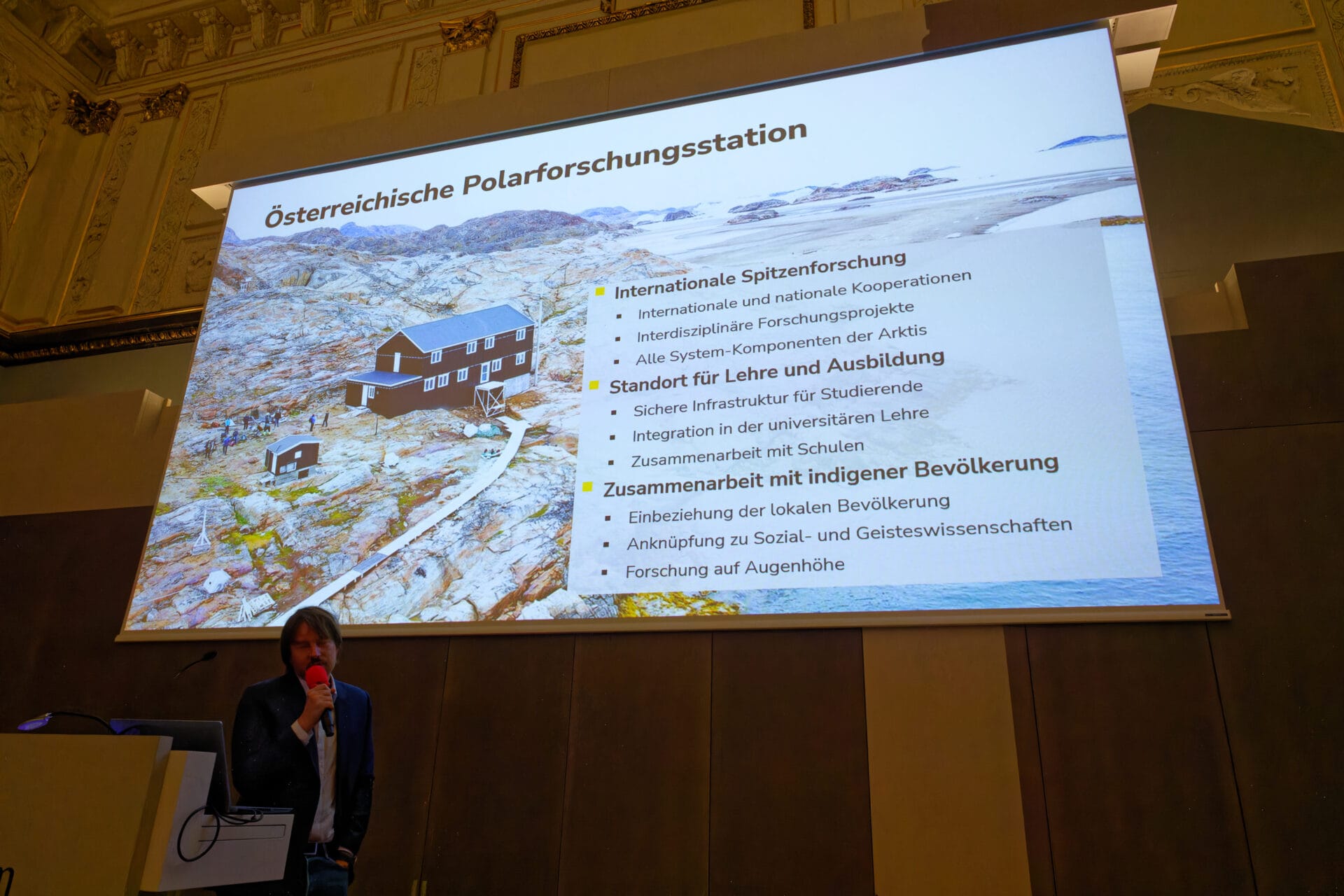
Polar Talk #19: Andreas Trügler explaining the research goals of Sermilik at the Natural History Museum Vienna (© Christoph Ruhsam)
APRI Art Exhibitions – Science meets art
APRI was part of two art exhibitions as a creative form of science communication to raise awareness of the importance of the polar regions and high mountains among a broad audience. These exhibitions combine scientific findings with artistic representations, thus creating an emotional approach to the complex challenges and consequences of climate change.
Exhibition “ICE – an aesthetic approach to an ephemeral good“
This exhibition opened on 20 May 2025 at Landhaus 2 in Innsbruck. It was organised by APRI in collaboration with the University of Innsbruck and supported by the Province of Tyrol. APRI Director Birgit Sattler and APRI members Klemens Weisleitner and Christoph Ruhsam played a key role in its creation. Based on numerous expeditions, they show the diversity and vulnerability of ice in 22 impressive images – from microscopic structures to large-scale ice landscapes. The exhibition combines scientific findings with an aesthetic approach and makes it clear that with the retreat and disappearance of glaciers, not only water reserves but also habitats, biodiversity and cultural identity are being lost.
Source: https://www.tirol.gv.at/presse/meldungen/meldung/ausstellung-eis-im-landhaus-2-in-innsbruck/
ICE exhibition promotion video (© Klemens Weisleitner)
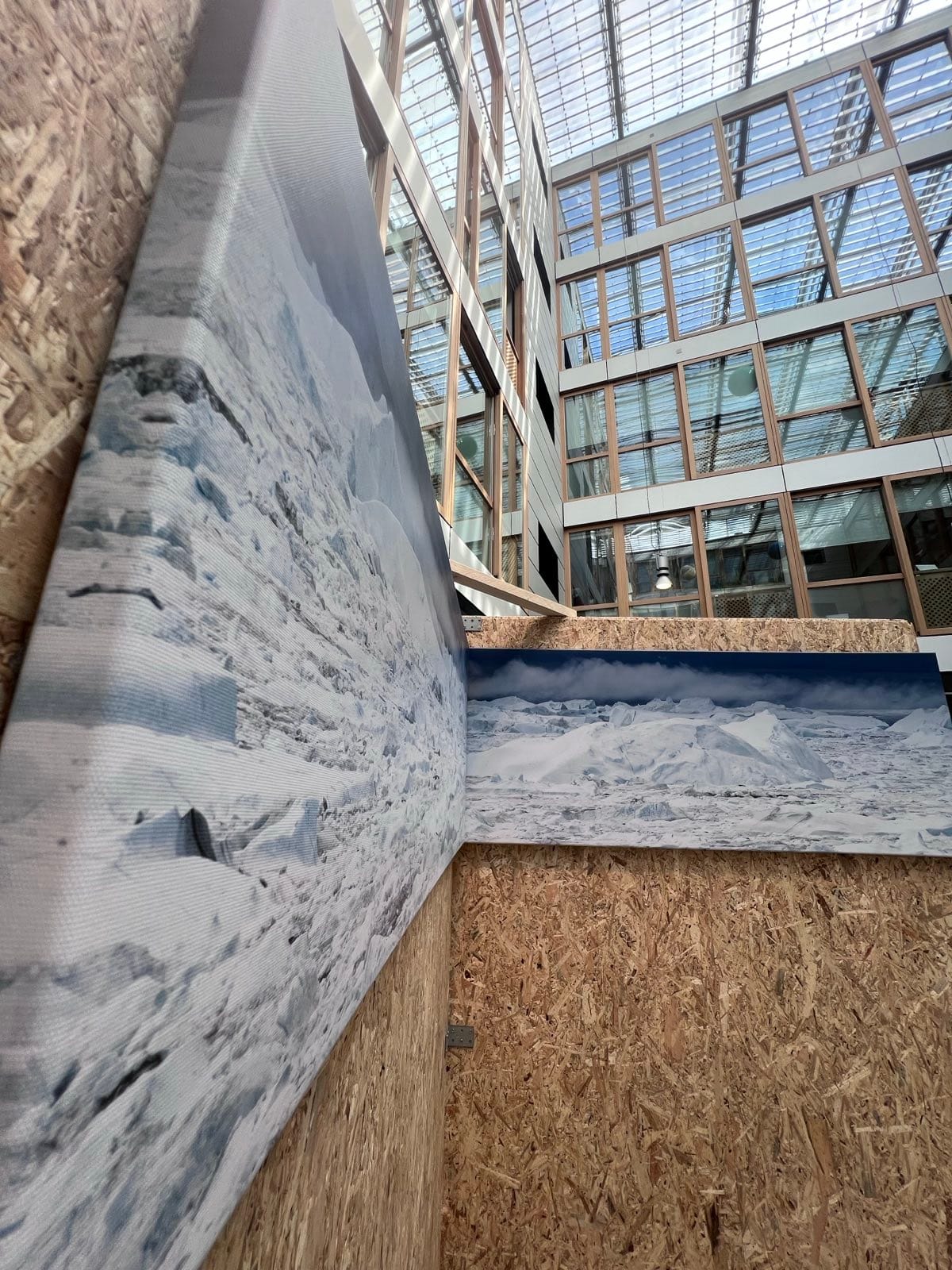
ICE exhibition (© Klemens Weisleitner)
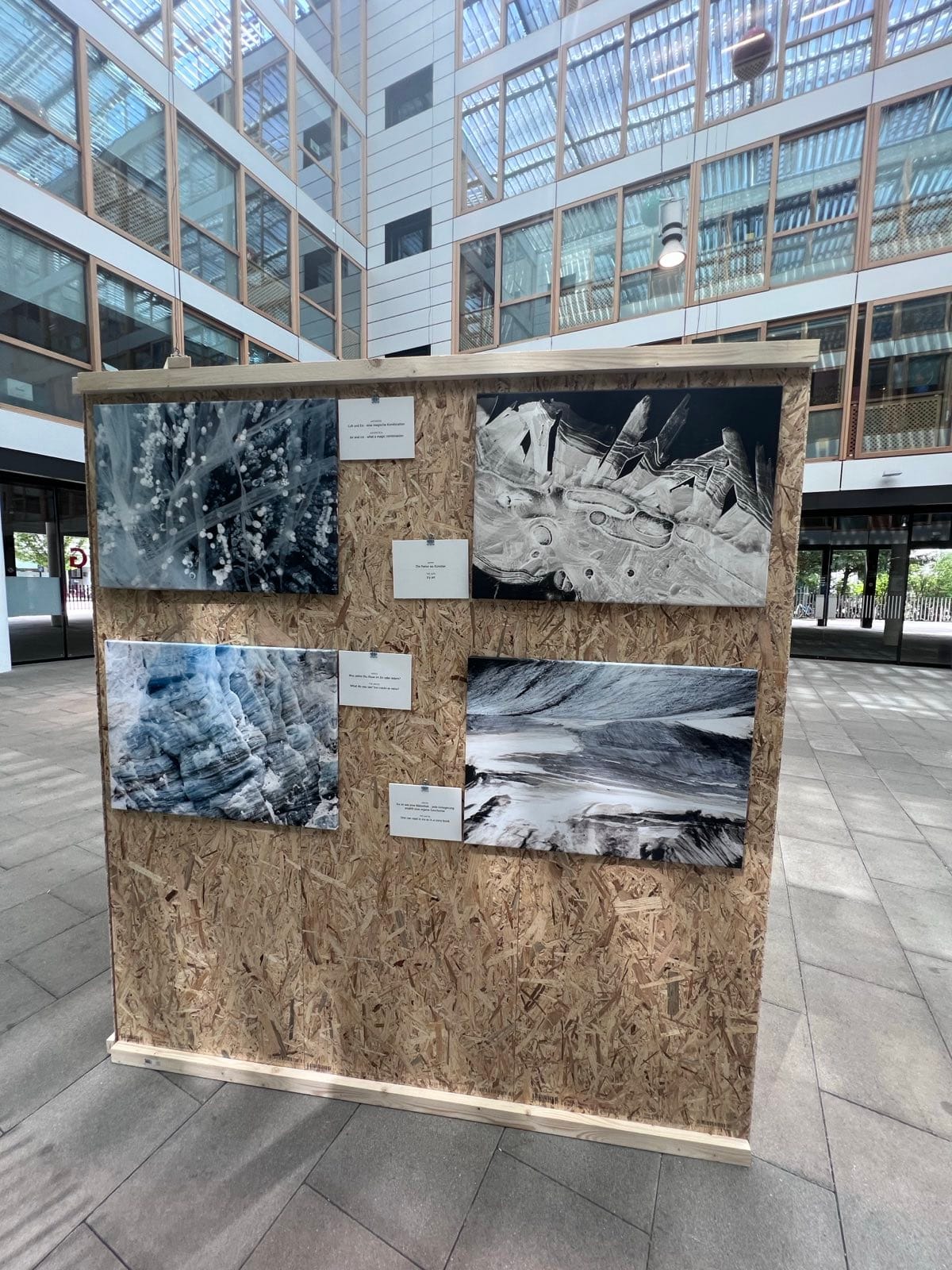
ICE exhibition (© Klemens Weisleitner)
Exhibition „Changing Planet“ – Polar regions and high mountains in the Anthropocene
From 26 November to 17 December 2025, APRI invited visitors to the Agnes Heller House in Innsbruck for the exhibition ‘Art Meets Science’. Researchers and artists from the Austrian Polar Research Institute and APECS Austria presented their experiences and perspectives on the effects of the Anthropocene on the polar regions and high mountains. The exhibition features artistic representations, impressive macro photographs of ice structures, and research equipment used in the Arctic and Antarctic. The aim is to highlight the beauty but also the vulnerability of ice and to raise awareness of the global impact of glacier melt.
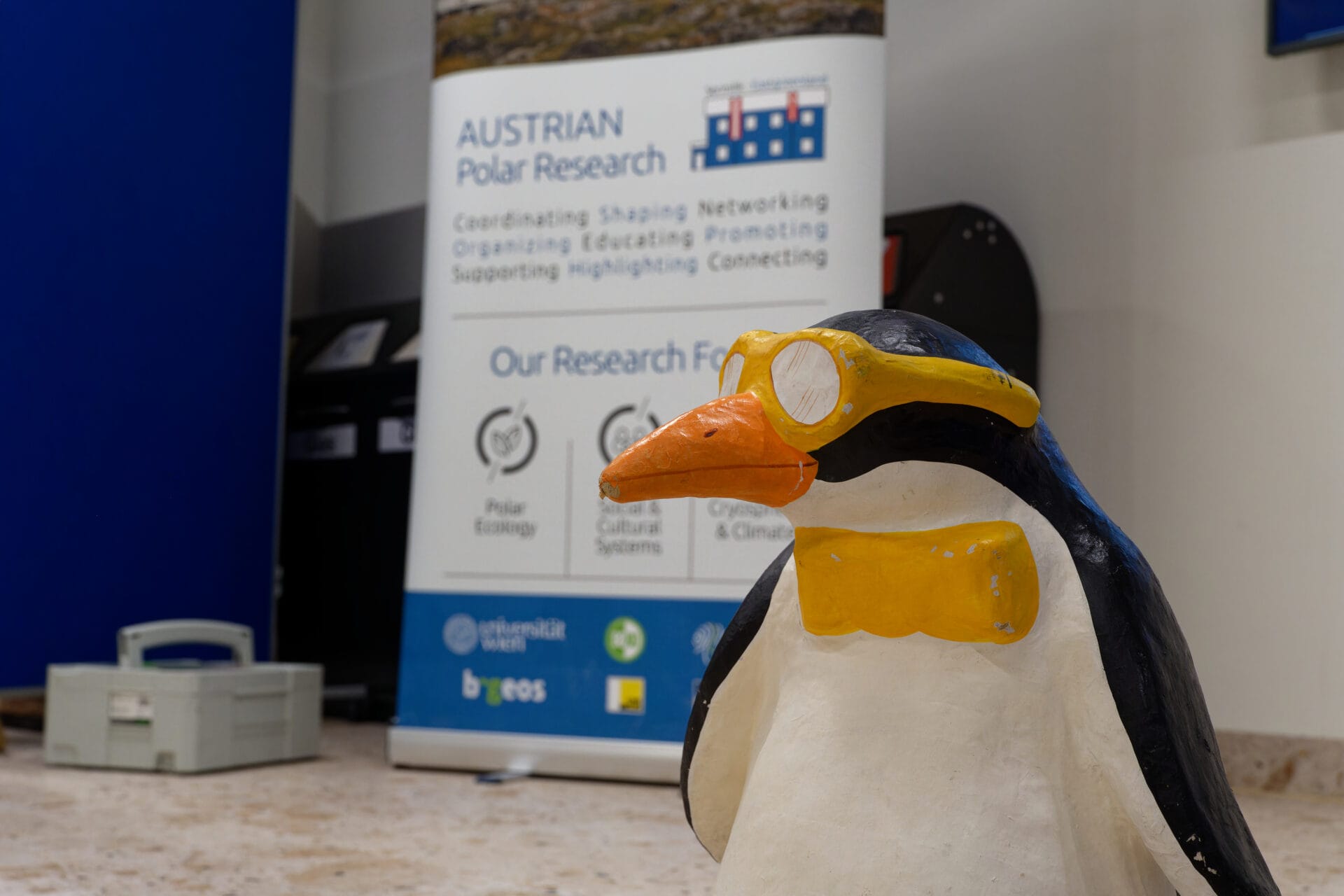
Changing Planet exhibition (© Christoph Ruhsam)
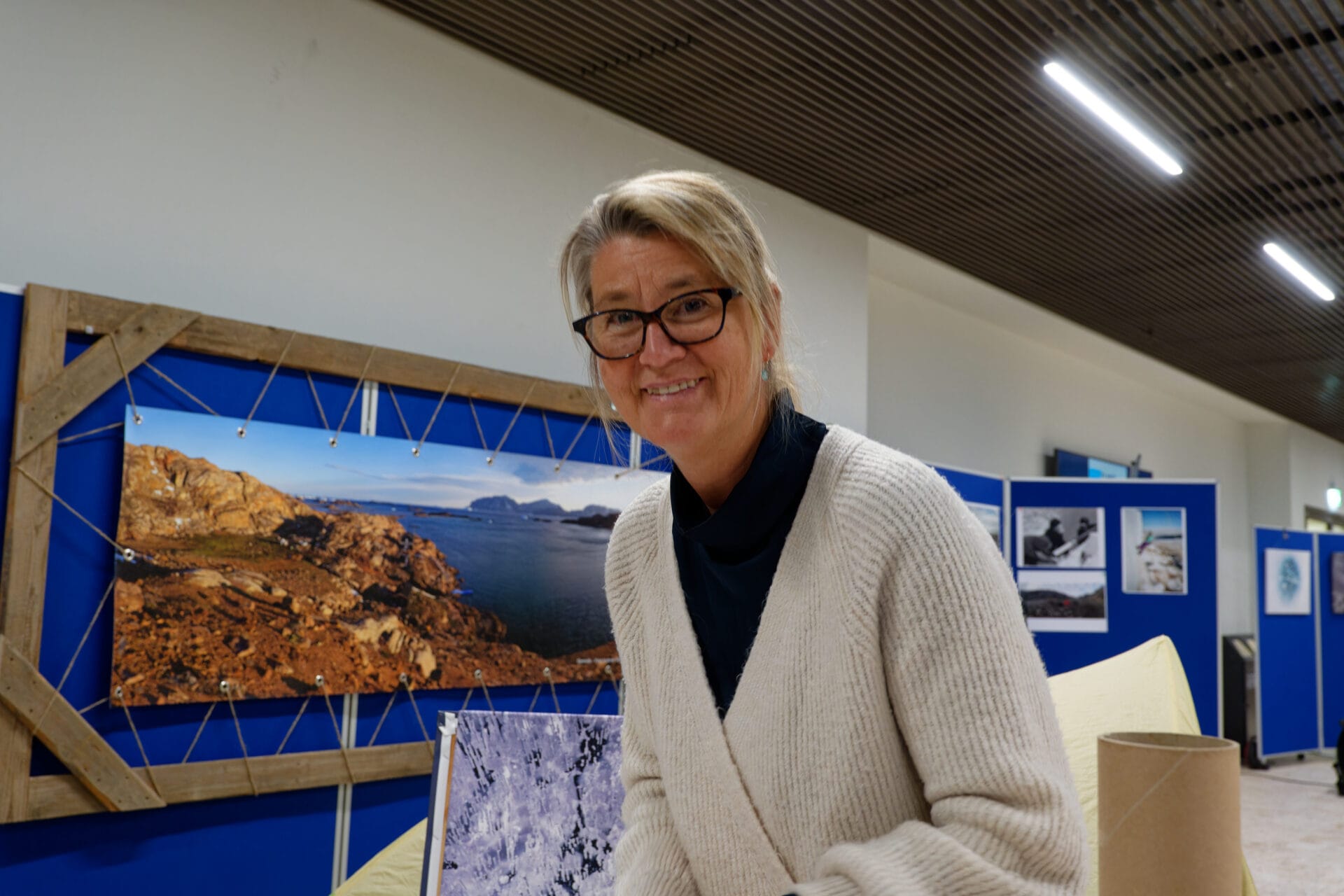
Changing Planet exhibition (© Christoph Ruhsam)
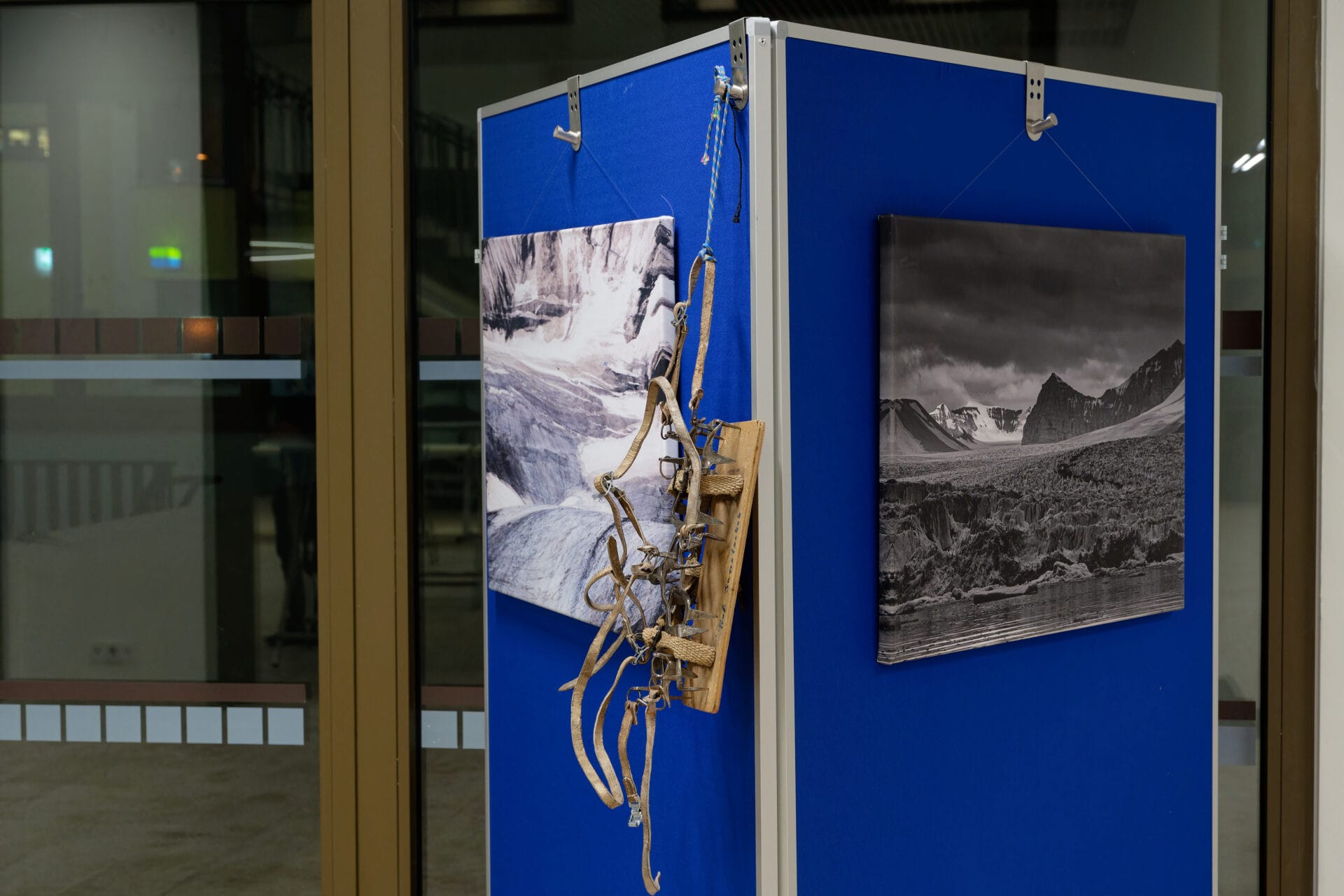
Changing Planet exhibition (© Christoph Ruhsam)

Changing Planet exhibition (© Christoph Ruhsam)
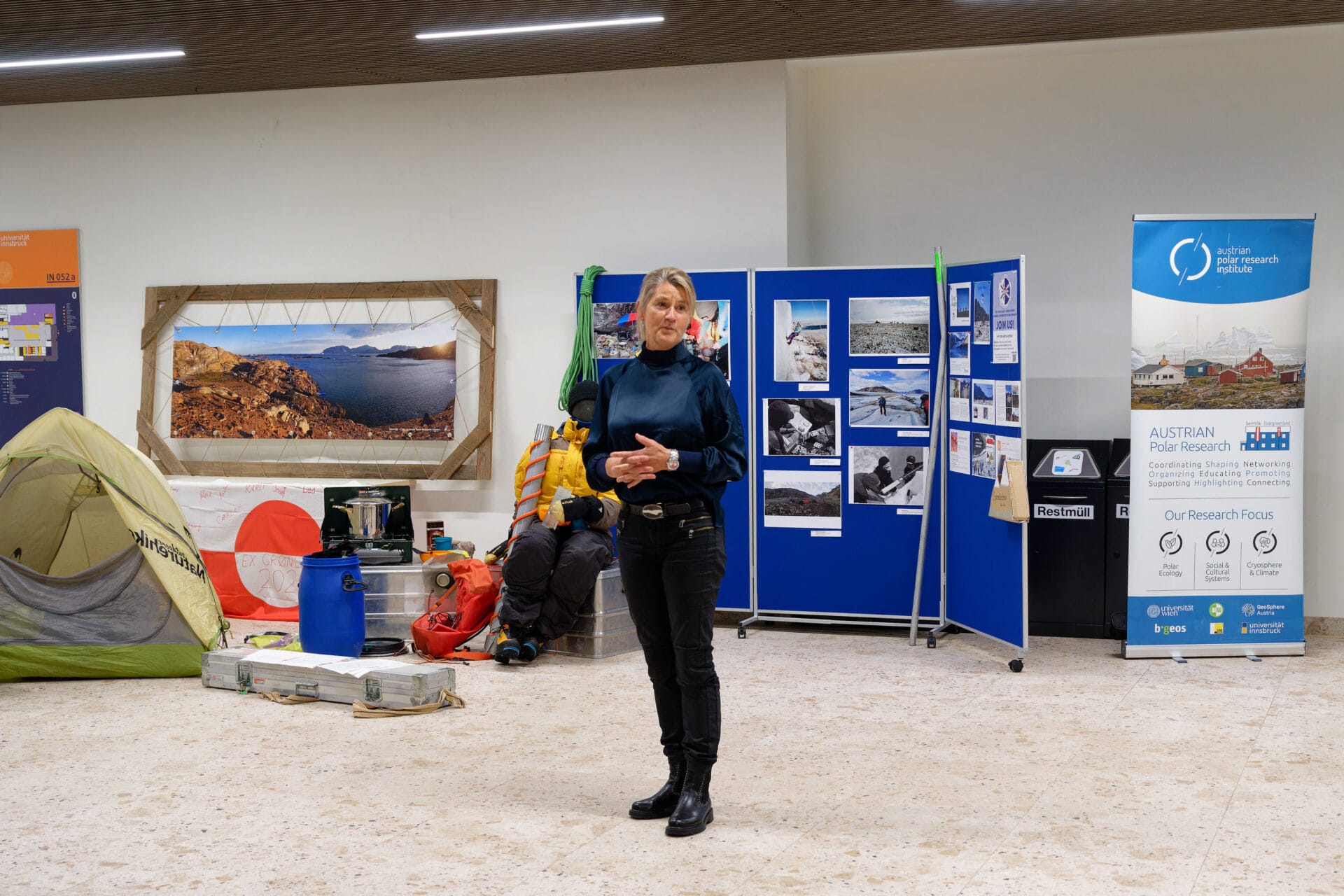
Changing Planet exhibition (© Christoph Ruhsam)

Changing Planet exhibition (© Christoph Ruhsam)

Changing Planet exhibition (© Christoph Ruhsam)

Changing Planet exhibition (© Christoph Ruhsam)
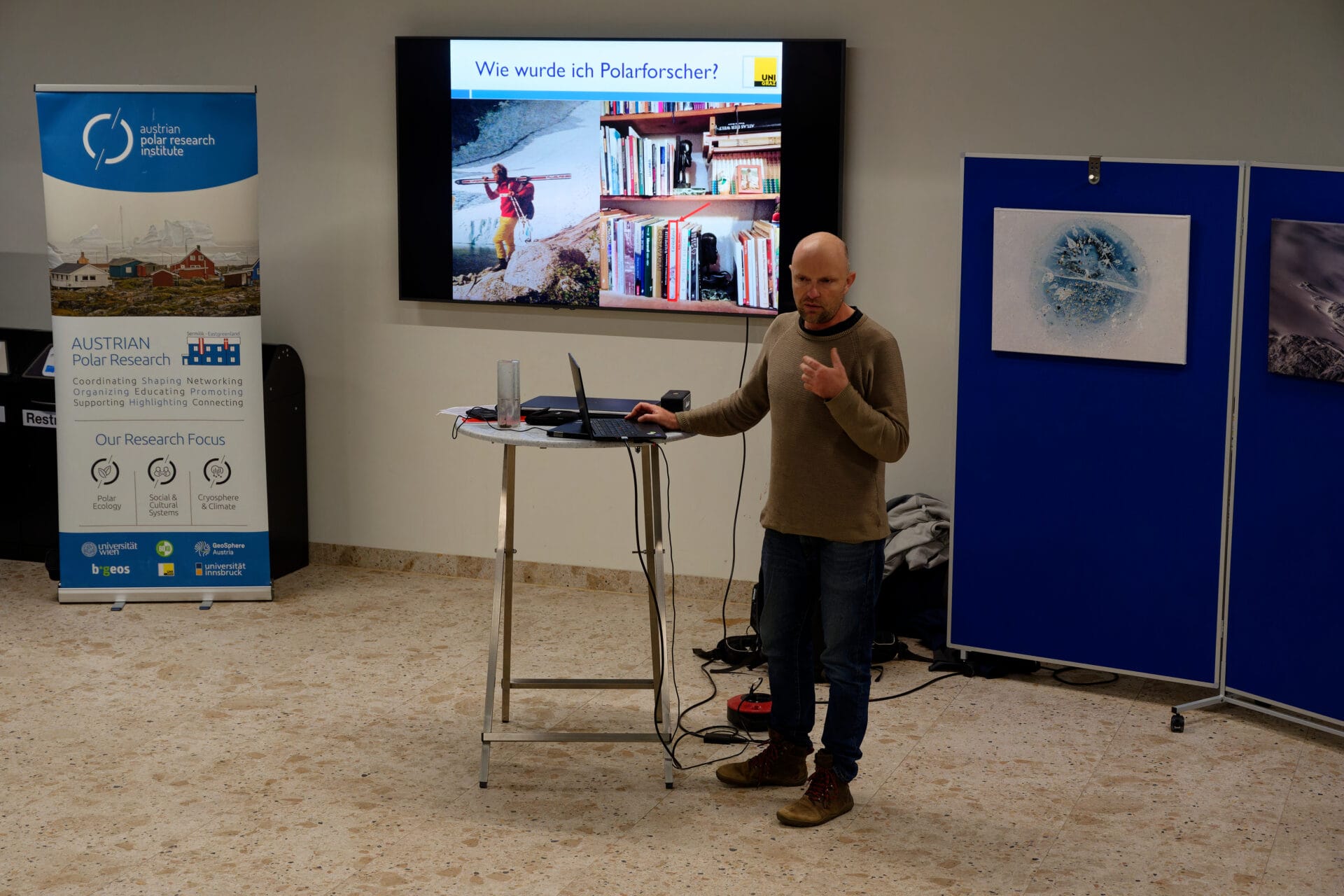
Changing Planet exhibition (© Christoph Ruhsam)
Podcast: The not-so-eternal ice
On 3 December 2025, glaciologist and APRI board member Bernhard Hynek from GeoSphere Austria spoke in the podcast “Mehr als Wind und Wetter” (More than Wind and Weather) about his many years of experience with glacier changes in Austria and Greenland. The episode highlights the causes and consequences of glacier retreat and shows why its effects extend far beyond mountain regions.
Source: https://www.geosphere.at/de/aktuelles/podcast/folge-11-das-nicht-so-ewige-eis
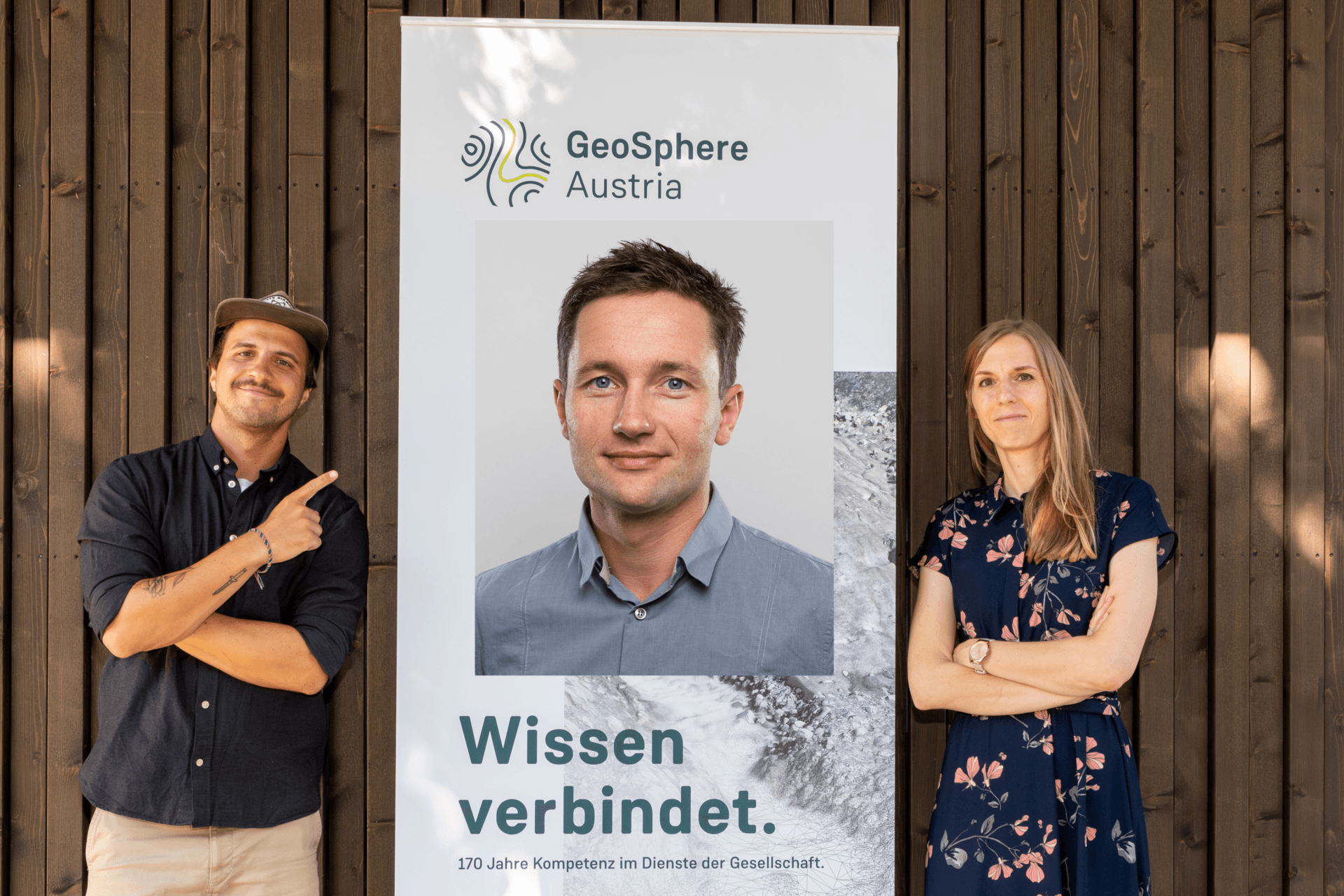
Christian Resch, Bernhard Hynek (on the poster) and Liliane Hofer (© GeoSphere Austria/Hynek)
Through lectures, research, exhibitions and international cooperation, APRI has impressively demonstrated during the International Year of Glacier Conservation how science can have an impact when it is made understandable, visible and tangible. Because what happens to the ice affects us all.
Media information
Written by Iris Hansche and Christoph Ruhsam, APRI-Media Team.
Contact: use our contact form.
Press review
- UNO: 2025 International Year of Glaciers’ Preservation
https://www.un-glaciers.org/en - APRI: Gletscher sind wichtig: APRI im Internationalen Jahr zur Erhaltung der Gletscher der UNO https://www.polarresearch.at/gletscher-sind-wichtig-apri-im-internationalen-jahr-zur-erhaltung-der-gletscher-der-uno/?lang=de
- APRI: Reaktion der Gletscher der Antarktischen Halbinsel auf den Klimawandel
https://www.polarresearch.at/reaktion-der-gletscher-der-antarktischen-halbinsel-auf-den-klimawandel/?lang=de - APRI: FREYA Gletscher: Lange nicht mehr gesehen!
https://www.polarresearch.at/freya-gletscher-lange-nicht-mehr-gesehen/?lang=de - APRI: Von Höhlen und Klimaveränderungen
https://www.polarresearch.at/von-hohlen-und-klimaveranderungen/?lang=de - UNI Graz: URBI Science Talk: Im Schatten des Klimawandels
https://urbi.uni-graz.at/de/neuigkeiten/urbi-science-talk-im-schatten-des-klimwandels/ - ORF Tirol: Internationales Projekt zum Gletscherschutz
https://tirol.orf.at/stories/3297618/ - DerStandard: Mehr Schmutz als Schutz: Die Krux mit dem Gletscherschutz https://www.derstandard.at/story/3000000258061/mehr-schmutz-als-schutz-die-krux-mit-dem-gletscherschutz
- UniKonkretMagazin: Interview mit Birgit Sattler über die Auswirkungen der Klimakrise auf die sensiblen Ökosysteme und Mikroplastik im Hochgebirge
https://cba.media/699736 - Alpen ohne Eis: https://geo.badw.de/fileadmin/user_upload/Files/GLAZ/pdf/ForumOEkologie_PROGRAMM-52-Alpen.pdf
- APA: Sermilik-Fjord wird neuer Stützpunkt für Österreichs Polarforscher
https://science.apa.at/power-search/10954600182497624655 - Land Tirol: Ausstellung „EIS“ im Landhaus 2 in Innsbruck
https://www.tirol.gv.at/presse/meldungen/meldung/ausstellung-eis-im-landhaus-2-in-innsbruck/ - UArctic: The Glacier Stewardship Program – an international team responding to the global loss of glaciers https://www.uarctic.org/news/2025/3/the-glacier-stewardship-program-an-international-team-responding-to-the-global-loss-of-glaciers/
- Harry Putz: Requiem in Weiss
https://freiluftdoku.com/requiem-in-weiss/
Weitere Beiträge
ENVEO joined APRI!
The KINDLE Project: Connecting Caves, Climate and Communities
Climate Change and Adverse Incidents in the Arctic
The Hunga Tonga eruption continues to have an impact on weather patterns

In the Shadow of Climate Change – What Remains of the “Eternal Ice”?

The Cold Truth: Antibiotic Resistance in the Cryosphere
Related articles
ENVEO joined APRI!
The KINDLE Project: Connecting Caves, Climate and Communities
Climate Change and Adverse Incidents in the Arctic
The Hunga Tonga eruption continues to have an impact on weather patterns
In the Shadow of Climate Change – What Remains of the “Eternal Ice”?